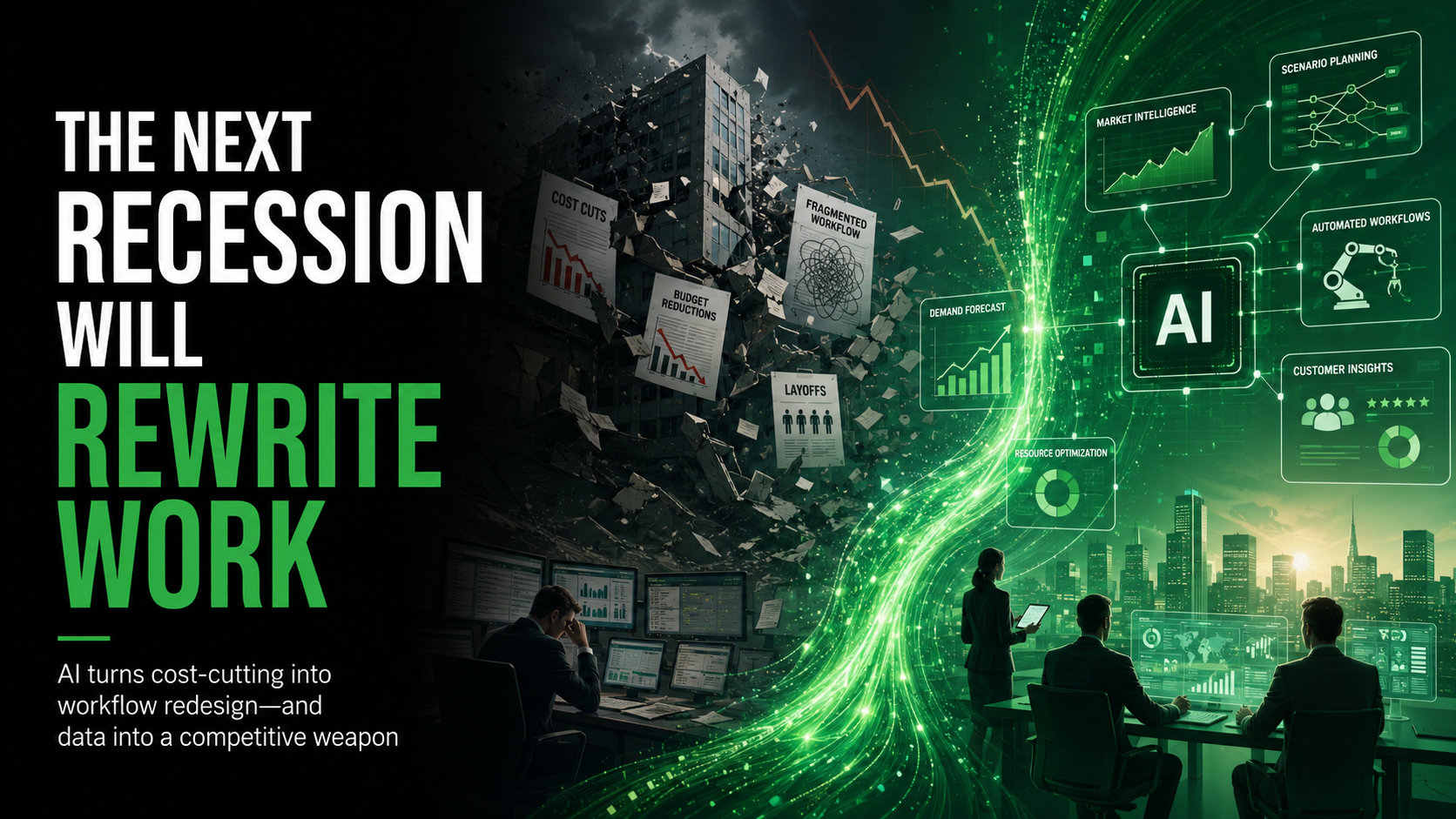
Historically, economic downturns have functioned as the ultimate arbiter of corporate survival. They are brutal, exogenous shocks that act as filters, separating the agile from the stagnant. In previous cycles—specifically the recessions of 1980, 1991, and 2008—surviving the contraction was largely a matter of defensive posturing. It was an era defined by manual cost-cutting, labor freezes, and the aggressive preservation of capital. However, as we stand on the precipice of the next global contraction, the fundamental rules of engagement have been rewritten.
For the first time in history, organizations are entering a recession equipped with the structural capabilities of Big Data and Artificial Intelligence. We have moved irrevocably beyond the era where data was merely a ledger of past performance—a digital rearview mirror. We are now in the age of Analytics 3.0, a paradigm where the combination of traditional statistical discipline and the high-velocity execution of AI allows for a total structural evolution of the firm. While past recessions were about survival, this one will be about the total liquidation of legacy thinking and the rapid redesign of work itself.
1. Every Recession Changes the Rules
Recessions serve as catalysts for technological adoption because they force an immediate, unyielding re-evaluation of efficiency. To understand why this upcoming era is unique, we must trace the lineage of how management has utilized information during periods of extreme economic stress. In the mid-20th century, data was an afterthought. By the 1970s, it became a “support” mechanism. Today, it is the product.
History of Crisis-Driven Innovation
- 1970–1985: Decision Support. This era saw the birth of using data analysis to support isolated, specific decision-making processes. It was manual, slow, and reactive.
- 1980–1990: Executive Support. A refinement of the previous era, focusing data analysis specifically on the high-stakes decisions made by the C-suite, often utilizing “Small Data” sets.
- 1989–2005: Business Intelligence (BI). The rise of standardized reporting. Organizations began to build data warehouses to support data-driven decisions, yet the focus remained heavily on what happened in the past.
- 2005–2010: Analytics. A critical shift toward statistical and mathematical analysis to predict future outcomes. This era moved firms from “What happened?” to “What will happen?”
- 2010–Present: Big Data & AI. The current era, characterized by massive, unstructured, and continuous streams of data used to power automated execution and entirely new classes of products.
In the “Small Data” eras of 1970 through 2005, data was a “static pool”—a collection of structured rows and columns used for internal support. In the modern AI era, data is a “constant flow.” It is no longer just a resource for managers to look at; it is the engine that powers external products and services. While previous recessions forced companies to use structured data to trim the edges of their budgets, the AI-era recession allows companies to harness unstructured formats—video, voice, genomic sequences, and sensor data—to weaponize their business models against the downturn.
2. What Makes an AI-Era Recession Different?
The transition from traditional analytics to the AI era changes the corporate response to economic pressure from a reactive stance to a proactive, execution-oriented model. Traditional responses relied on hypothesis-based models: a manager would develop a theory about where to cut costs and then pull data to test it. This process was glacially slow, manual, and prone to “HiPPO” (Highest Paid Person’s Opinion) bias.
In a recession, time is the one asset no company can afford to waste. The AI era replaces hypothesis with continuous discovery. Machine learning allows algorithms to scan billions of data points to find correlations that a human manager would never think to test. The following table illustrates the shift in how leading firms will respond to the next economic downturn compared to the legacy methods of the past:
| Feature | Traditional Recession Response | AI-Era Recession Response |
| Data Type | Structured (Rows and Columns) | Unstructured (Text, Video, Sensors, Voice) |
| Data Volume | Tens of Terabytes or less | Petabytes and beyond |
| Flow of Data | Static pools / Batch processing | Constant, high-velocity streams |
| Analysis Method | Hypothesis-based / Manual | Machine Learning / Automated Discovery |
| Primary Purpose | Internal Decision Support | Product/Service Execution & Innovation |
| Lead Time | Weeks or Months | Real-time or Minutes |
| Strategic Stance | Defensive (Cost Cutting) | Offensive (Workflow Redesign) |
The “Small Data” era was fundamentally disadvantaged by organizational silos. In a downturn, those silos prevented a holistic view of the company, leading to across-the-board cuts that often decapitated the company’s future growth. Today’s AI-native operating models thrive on “Variety”—the ability to analyze data from diverse sources like social media, GPS tracking, and industrial sensors—to make surgical adjustments that were previously impossible.
3. AI Changes the Economics of Work
The primary reason AI will change the next recession is a radical, order-of-magnitude shift in the price-performance ratio of information processing. Historically, storing and analyzing massive amounts of data was prohibitively expensive. During lean years, IT departments were the first to “purge” data, deleting unstructured sources to save on storage costs and focusing only on essential accounting records.
Modern technologies like Hadoop and MapReduce have shattered these cost barriers. Hadoop—an open-source framework for processing data across parallel servers—allows for a level of scalability that traditional relational databases simply cannot match. In a capital-constrained recession, the 15x cost reduction afforded by modern data stacks is the difference between a company maintaining its R&D budget or undergoing catastrophic layoffs.
Economic Reality Check
- Traditional Relational Database: Storing 1 Terabyte of data can cost approximately $37,000 per year.
- Big Data Hadoop Cluster: Storing the same 1 Terabyte of data costs approximately $2,000 per year.
This represents a 15x to 18x cost reduction in the fundamental infrastructure of organizational intelligence.
When the cost of “knowing” drops by this margin, corporate strategy during a recession shifts from data deletion to data hoarding. As Jeff Bezos of Amazon famously noted, “We never throw away data.” In a recession, this stored data becomes the “raw material” for finding new efficiencies.
Hadoop allows for a unified storage and processing environment. It is not just about having the data; it is about the ability to process it across multiple computer nodes. Splitting a computing task—such as comparing thousands of customer voice files to identify churn markers—across multiple servers can reduce processing time from weeks to minutes. For a C-suite executive, this means the ability to pivot the entire organization in real-time as economic conditions worsen.
4. From Cost Cutting to Workflow Redesign
In past recessions, the goal was labor reduction: doing the same work with fewer people. This usually resulted in “survivor syndrome,” where the remaining employees were overworked and less productive. In the AI era, the goal is workflow redesign: changing the nature of the work so that AI handles the “Production” of value (scaling existing insights) while humans focus on the “Discovery” of new opportunities.
Consider the “Macy’s Rule”: Macy’s weaponized high-performance analytics (HPA) to optimize pricing for 73 million items. Historically, this calculation took 27 hours, meaning the company could only adjust prices once a week at best. By shifting to a Big Data architecture, they reduced this cycle to 1 hour.
“Speed allows for more models, more variables, and more frequent iterations, not just fewer employees.” — The fundamental principle of AI-driven efficiency.
This speed is not just a convenience; it is a strategic advantage. If an organization can run 100,000 models on granular data instead of just 10 aggregate models, they can find microscopic efficiencies—price elasticities in specific zip codes or for specific SKU combinations—that were invisible in the “Small Data” era. In a recession, these margins are the difference between profit and loss.
UPS and the Instrumentation of Labor Similarly, UPS redefined its routes using telematics and sensor data. This was not a traditional management exercise in telling drivers to drive faster. It was about “instrumenting” the brown trucks to collect data on acceleration, braking, and idle time. This data allowed UPS to redesign their route structure—only the third such redesign in over a century. By analyzing the “Industrial Internet” of their fleet, UPS created massive fuel and time savings that traditional manual analysis or “gut feel” could never have uncovered. They moved from a model of managing people to a model of managing a data-driven system.
5. The Rise of AI-Native Operating Models
The most resilient companies in the next recession will be those that have adopted an “AI-Native” operating model. These companies don’t just “use” AI; they build their entire value proposition around continuous data flow.
General Electric (GE) and the Industrial Internet GE provides the blueprint for this shift, moving from selling industrial hardware to selling “Things that Spin.” By embedding sensors in locomotives, jet engines, and gas turbines, GE has created what they call the “Industrial Internet.” They have even branded their digital transformation efforts with labels like “Datalandia” and “Predicity.”
- Gas Turbines: GE monitors over 1,500 turbines from a centralized facility. By optimizing software and harmonizing gas/power systems, they target a 1% efficiency improvement.
- Economic Impact: That 1% improvement translates to $66 billion in fuel savings over 15 years for their customers.
This is a total liquidation of legacy business models. In a recession, a company selling a “locomotive” as a one-time transaction struggles because capital expenditures are frozen. A company like GE, selling “guaranteed fuel savings and 99% uptime” through predictive maintenance, thrives. They are no longer selling a machine; they are selling a data-verified outcome.
To achieve this level of resilience, an organization must master the Five Layers of the AI-Native Stack:
- Storage: Utilizing low-cost commodity hardware and HDFS (Hadoop Distributed File System) to house petabytes of diverse data.
- Platform Infrastructure: The execution engines like MapReduce that process data in parallel, allowing for high-performance computation.
- Data Management: The governance of diverse sources, including real-time sensor streams and unstructured text, ensuring “data provenance” and quality.
- Application Code: The move beyond legacy languages to interactive scripting languages like Python, Pig, and Hive. These tools allow data scientists to manipulate data at scale without the friction of traditional software development cycles.
- Business View: The creation of models, “cubes,” and visualizations that make the data consumable for high-stakes C-suite decisions.
6. What This Means for Sales and Knowledge Work
Knowledge work—specifically sales and customer service—has historically been a “black box” where headcounts were slashed during recessions because ROI was difficult to prove. AI changes this by “industrializing” the flow of knowledge work, allowing firms to increase output without increasing staff.
United Healthcare: Predicting the Unspoken United Healthcare (UHC) provides a masterclass in using AI as a defensive recessionary shield. Customer attrition is a multi-billion dollar problem in insurance. In the past, companies analyzed structured data (billing issues, age of account) to predict who might leave. UHC went deeper, utilizing natural language processing (NLP) on the massive volume of recorded voice files from their call centers.
By analyzing the “sentiment” and specific linguistic markers in customer calls, UHC’s AI can identify customers who are showing signs of extreme dissatisfaction long before they actually cancel their policy. This allows for a “surgical intervention”—a proactive call or offer—targeted precisely at the customers most likely to churn. In a recession, where acquiring a new customer is 10x more expensive than retaining an old one, this AI-driven attrition model is a vital survival mechanism.
The LinkedIn “Growth Engine” LinkedIn’s development of the “People You May Know” (PYMK) feature illustrates how AI can drive growth during a downturn without a proportional increase in sales headcount.
- The “Triangle Closing” Logic: Data scientists identified that if a user knows Person A and Person B, they are mathematically likely to know Person C if A and B also know C.
- The Result: PYMK achieved a 30% higher click-through rate than any other prompt on the site, shifting LinkedIn’s growth trajectory upward.
- The Lesson: In a recession, growth can be automated. You don’t need a larger sales force; you need better algorithms to find the “next best offer” for your existing network.
Case Study in Automation: The LinkedIn PYMK Sidebar
At LinkedIn, the “People You May Know” (PYMK) feature was initially a “hunch” by data scientist Jonathan Goldman. Traditional product engineers were skeptical, but Goldman used the “Trusted Adviser” trait to bypass the hierarchy and run a test. By analyzing the massive “social graph” of unstructured connections, the AI could suggest connections with uncanny accuracy. This didn’t just increase engagement; it created a self-sustaining growth loop. For a business leader, this represents the shift from “hiring to grow” to “coding to grow.”
The New Workforce: Trusted Advisers and Hackers This shift necessitates a new type of employee. We are moving away from the “HiPPO” model of decision-making toward a collaboration between two new roles:
- The Hacker: The data scientist who can code in Python or Pig, who understands the “Big Data Stack,” and who has the “Scientist” trait of restless experimentation.
- The Trusted Adviser: The professional who can frame the business problem, interpret the AI’s “discovery,” and communicate it to the C-suite.
7. The Companies That Will Be Ready
Recession readiness is no longer measured by the size of a company’s cash reserve alone. It is measured by the DELTTA Model. This framework separates the “Analytics 1.0” firms (who are about to be disrupted) from the “Analytics 3.0” firms (who will dominate).
The DELTTA Readiness Checklist:
- Data: Do you have a “constant flow” of unstructured data? Are you looking at external information (sensors, genomic, social) rather than just internal accounting?
- Enterprise: Are your AI capabilities siloed in IT, or are they integrated into the DNA of marketing, finance, and product development?
- Leadership: Does your C-suite view AI as a “cost to be managed” or a “strategic differentiator”? Are you willing to sponsor “Discovery” labs where failure is seen as data collection?
- Targets: Have you identified the specific business processes—pricing, supply chain, or attrition—where AI can have the biggest impact?
- Technology: Have you moved beyond legacy warehouses to a coexistence model that includes Hadoop and in-memory analytics? Note: We separate Technology from Data because the stack itself (the “T”) is now a distinct competitive advantage over legacy architectures.
- Analysts: Do you have “Horizontal Data Scientists” who understand both the code and the business context?
Action Plan for Managers:
- Look Outward: Have you considered how video, voice, or sensor data could change your industry?
- Continuous over Batch: Are you moving toward a “continuous” approach to decision-making rather than waiting for monthly “batch” reports?
- The Big Bet: Have you made a “big bet” on the structural redesign of your most expensive workflows?
Redesigning Work, Not Just Cutting Costs
The next recession will be a permanent dividing line in the history of global business. On one side will be the traditional firms that respond with the “slash and burn” tactics of 2008. These companies will likely find that they have cut so much “muscle” that they cannot compete when the market returns.
On the other side will be the AI-native firms. These organizations will use the economic pressure of the downturn to accelerate their structural evolution. They will use Hadoop to slash their IT costs by 15x. They will use NLP to retain their most valuable customers. They will use the “Macy’s Rule” to iterate their pricing while their competitors are still waiting for last week’s reports.
The “Analytics 3.0” philosophy teaches us that the greatest value comes not from the volume of the data, but from the speed of the execution. Success in the coming economic cycle belongs to those who view a recession not as a time to hide, but as an opportunity to redesign the very nature of work.
Executive Directive:
The goal is no longer to do more with less; the goal is to do work differently because AI can do more of it. Do not just cut costs—redesign the very nature of how your company creates value. The next recession will reward those who weaponize data to liquidate legacy models and build the AI-native future.