The internet is being read by a new kind of visitor, and most marketing teams have not updated their welcome mat. For two decades, the fundamental unit of digital marketing was the human eyeball: the person who typed a query, scrolled a page, registered a color palette, absorbed a message, and eventually clicked a button. That assumption is quietly dissolving. A growing share of discovery, comparison, and even purchasing is now delegated to software agents, AI systems that browse the web on behalf of their owners, read what a page actually says, and make decisions in milliseconds. When the visitor is a machine, the entire grammar of branding changes. A hero image means nothing to a model that parses HTML structure. A tagline buried inside a carousel is invisible to a tool that extracts meaning from text. And a website that looks beautiful but communicates poorly to machines may as well not exist.
This shift is not science fiction. It is already visible in the way consumers use ChatGPT, Perplexity, Claude, and a dozen other assistants to research products before they buy. It is visible in the rise of browser-based agents that can compare prices, check inventory, and complete a checkout without the human ever visiting a brand page directly. Forrester research has quantified the direction of travel: 72 percent of customer experience managers already believe AI agents will soon act as the primary brand representatives for their organizations. The same research warns that brand loyalty is projected to drop by 25 percent as agents optimize for efficiency, price, and factual accuracy rather than aesthetics, emotion, or habit. In other words, loyalty that took decades to build can be bypassed in a single API call.
The Web Has a New Primary Customer
For most of web history, brands designed for humans and then did their best to make their pages legible to search engines. The search engine was the intermediary, and the ranking algorithm was the gatekeeper everyone learned to appease. The agentic era removes the middleman in a strange way: the machine that ranks you is now also the machine that reads you, summarizes you, and potentially buys from you. Agents do not view a website the way a person does. They consume the underlying structure, the Document Object Model, the metadata, the schema, and the plain text, and they execute tasks through bridges that connect a page’s content to an agent’s capabilities. This is a fundamentally different medium. A brand that wins in this medium is not necessarily the one with the most beautiful site; it is the one whose digital body is easiest for a machine to understand, trust, and act upon.
The practical consequence is what marketers are starting to call the Post-App era. The interfaces that used to matter, the mobile app, the responsive site, the landing page, become secondary. What matters is how your product is represented inside the reasoning of an agent at the exact moment a decision is made. This representation is not a logo and it is not a slogan. It is structured, factual, verifiable context: what the product does, who it is for, how it is priced, why it beats the alternative, and what happens after the purchase. If that context is missing, vague, or wrong, the agent will fill the gap with a guess, and the guess will usually favor a competitor that bothered to be explicit.
The Price of Invisibility in the Post-App Economy
Think about what happens today when someone asks an assistant to find a good project management tool for a fifteen-person remote team. The assistant does not admire design. It evaluates features, pricing transparency, integrations, reviews, and the coherence of the information it can extract. If your product page contains rich, structured, unambiguous information, you have a chance to be cited and recommended. If your value proposition is implied by imagery and buried in marketing-speak, the agent will synthesize an answer from whoever made their facts easiest to harvest. The transaction can happen in seconds. Forrester’s scenario of a three-second, fully agent-mediated purchase is not hyperbole; it is a design goal for many agent builders. In that world, the brand application itself becomes what some strategists call an Invisible Backend: a system that does real work but is never seen by the human who benefits from it.
The uncomfortable truth is that most brands are not ready. Their websites are built for humans, their marketing materials are built for humans, their analytics measure human behavior, and their brand guidelines talk about color and typography as if those were still the primary carriers of identity. None of that is useless, but all of it is secondary now. The primary carrier of identity in the agentic economy is context. The brand that survives is the brand that can be described accurately, favorably, and completely by a machine that never saw its homepage.
Product Marketing Context: A Single Source of Truth for Machines
This is where the idea of a Product Marketing Context, or PMC for short, comes in. A PMC is a machine-readable file, typically stored in the repository of the product or marketing organization, that acts as the ground-truth intelligence layer for every agent that touches your brand. Think of it as a briefing document written not for a new employee but for an AI: precise, structured, current, and complete enough that any agent can represent your product honestly without hallucinating, improvising, or falling back on generic descriptions.
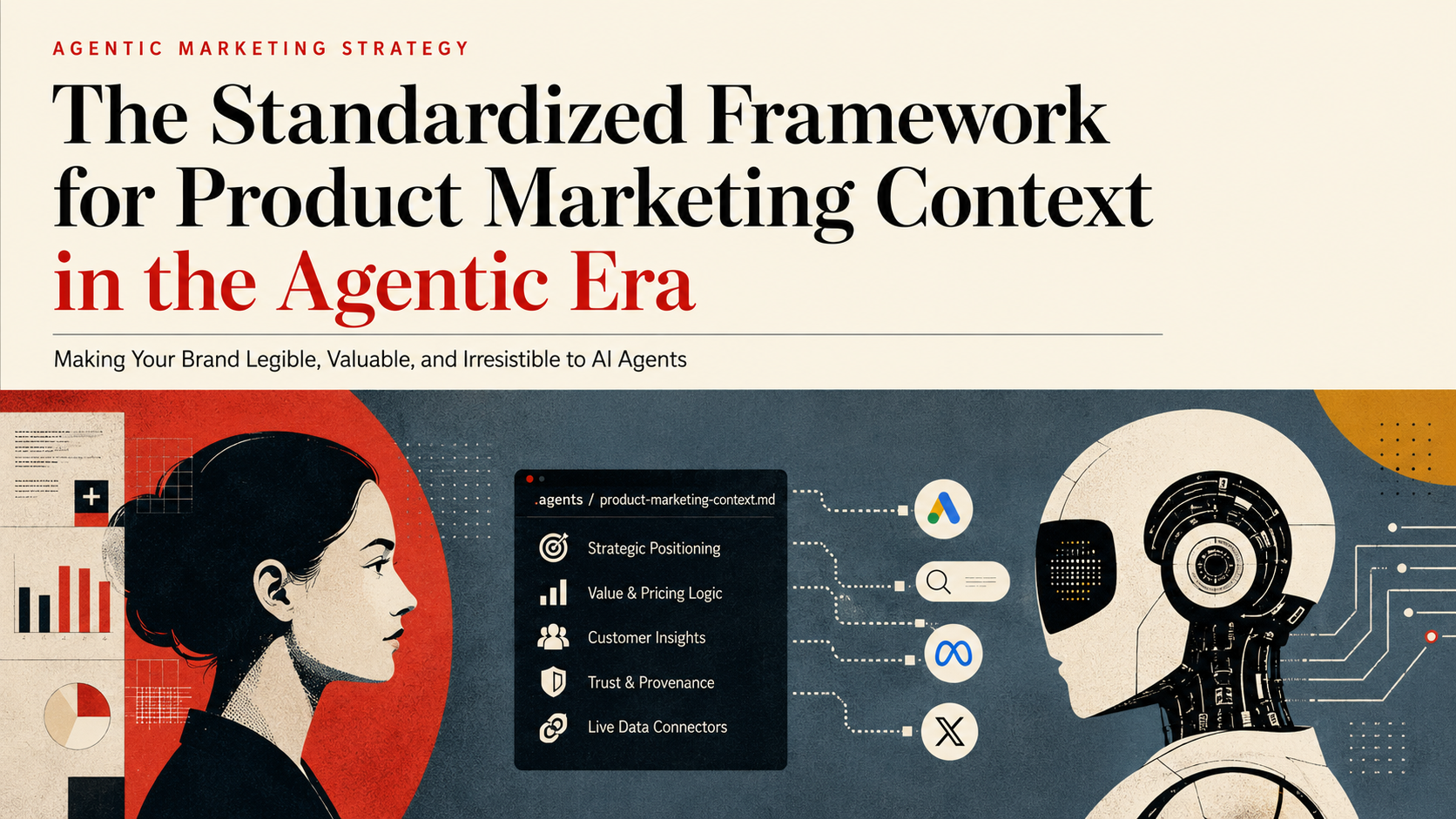
The most practical form is a markdown file placed in a standard location, for example .agents/product-marketing-context.md in the root of your project or content repository. Markdown is a deliberate choice: it is human-readable, diff-friendly, versionable, and trivially parseable by agents. Because the file lives in version control, every change is tracked, reviewable, and reversible. Because its location is standardized, any agent or tool in your ecosystem knows exactly where to look. The file becomes the canonical answer to the question every agent asks before it represents you: what is this product, and why should anyone choose it?
What a High-Fidelity PMC Must Contain
A PMC that merely states your product name and a tagline is worse than none, because agents will trust it and spread its emptiness. A high-fidelity PMC documents the dimensions that actually drive machine-mediated decisions. In practice, that means seven building blocks:
- Product definition: the core technical capabilities and the unique utility they create, described in language an agent can compare against alternatives.
- Target customer personas: granular pain points, demographic triggers, and buying context, not vague audience buckets.
- Value-based pricing logic: the monetization strategy, tier structures, and discount rules, plus the reasoning that connects price to delivered value.
- Strategic positioning: a definitive mapping of the competitive landscape, including the explicit X Alternative that you win against.
- Aha moments: the specific event or trigger that defines when a user realizes the product’s value.
- Time-to-value benchmarks: precise speed-of-utility metrics, measured in minutes or seconds wherever possible.
- Conversion killers: documented friction points and common objections, with the mitigations an agent should offer on your behalf.
Each of these blocks matters because agents answer questions by assembling evidence. When a prospective buyer asks whether a tool is worth it for their team, the agent is not looking for adjectives. It is looking for concrete signals: a defined persona that matches the questioner, a time-to-value number it can weigh, pricing logic it can compare, and a list of known objections with credible answers. A PMC that supplies those signals turns the agent from a neutral summarizer into a well-briefed salesperson who happens to work for you.
Notice what is absent from this list: slogans, brand stories, and aesthetic descriptions. That is not an oversight. In agent-mediated conversations, emotional branding does not transfer the way it does between humans, at least not yet. What transfers is logic, evidence, and specificity. The PMC is where marketing gets translated into the vocabulary of decision-making.
Data Connectors: Turning a Static Document into a Living Brain
A static PMC file is a great start and a fast liability. Markets move, prices change, campaigns launch, and competitors reposition. If your PMC describes last quarter’s reality, agents will confidently spread last quarter’s truth, which is worse than saying nothing because the confident error erodes trust. The solution is to connect the PMC to live data. Modern agent platforms make this practical through connectors that feed real signals into the context layer.
Connectors such as google-ads-connect and meta-ads-connect bring campaign performance into the picture, so the agent knows which messages are actually converting rather than which ones a copywriter happened to like. Search Console integration shows what people are really searching for and whether your pages earn clicks or just impressions. Social research tools such as TweetClaw scan X and other public conversation spaces to keep your positioning aware of how the market talks about your category today. When these connectors are wired in, the PMC stops being a document and becomes a dashboard of market reality. It becomes an engine that can, for example, identify keywords that burn budget with zero conversions and autonomously propose or apply fixes, without waiting for the monthly review meeting.
A Template You Can Adopt This Week
Teams that want to move fast do not need to invent a structure from scratch. A workable PMC template organizes the essentials into four clusters. The first cluster covers core identity and utility: product name, the primary value proposition, and the granular personas that matter most. The second cluster covers strategic positioning and what is now called GEO focus: the positioning statement that explains how you win against the named alternative, the aha moment that defines success, and the time-to-value benchmark you are willing to be measured against. The third cluster handles financial logic: pricing strategy, monetization model, and the top friction points that kill conversions. The fourth cluster addresses trust and provenance: content credentials such as C2PA verification status and the hashing protocol that proves your materials are authentic. Four clusters, one file, and suddenly every agent in your stack speaks from the same source of truth.
Generative Engine Optimization: The New Battlefield for Visibility
Search as we knew it is being cannibalized by answers. The rise of no-click searches, queries answered entirely inside ChatGPT, Perplexity, Claude, Gemini, and their cousins, means that organic traffic is no longer the only prize, and for many categories it is not even the main prize. The new prize is being the source that an engine cites. In the era of Generative Engine Optimization, or GEO, your product exists in the mind of the buyer only if it exists in the citation graph of the assistant they trust.
GEO demands a different content discipline than classic SEO. Link-building matters less; citation-mining matters more. An agent constructing an answer looks for claims it can extract, attribute, and verify. Content written in fluffy marketing language is useless to it; content written as analytical, evidence-based statements is gold. The practical translation is to structure claims so they can be lifted out of context and still make sense. State numbers with their source. Name the trade-offs honestly. Answer the question fully in the first paragraph instead of teasing the answer below the fold. Write for the reader who will never scroll, because the agent that represents them will not scroll either. It will extract, evaluate, and move on.
This is a humbling shift for teams trained on SEO folklore. Keywords still matter, but as semantic anchors rather than magic strings. Backlinks still matter, but as credibility signals rather than ranking fuel. What matters most is whether an agent can pull a defensible claim from your content and feel safe attributing it to you. That is the new definition of being visible.
Taste as a Moat: Why the Humanize Filter Matters
If utility becomes a commodity, and in an agentic world it rapidly does, the remaining defensible ground is taste. Aesthetic judgment, editorial voice, and the indefinable quality of feeling human are moats that cannot be copied by a cheaper model or a faster pipeline. This is where the humanize movement in AI content gets its strategic purpose. Tools and skills that add natural variation, rhythm, and emotional resonance to machine-written text are often discussed as ways to pass AI detectors. That framing misses the point. The real purpose is to pass something more important: the taste filter of readers who have grown numb to the sameness of generated prose. One popular humanize skill, for example, has been downloaded more than 8,771 times, which tells you how widespread the problem of robotic sameness has become. Trust in an era of automated content flows to humans who sound like humans, and, increasingly, to the human readers whose preferences train the next generation of agents.
Consider what happens when every competitor in a category publishes AI-generated articles with the same structure, the same cadence, and the same hollow authority. Readers stop reading, agents stop citing, and the whole category turns into noise. The brand that keeps editorial judgment, point of view, and genuine specificity becomes the brand that stands out to both humans and the models trained on human preference. Human taste is not a soft skill anymore. It is a competitive moat.
WebMCP: The Technical Bridge to the Agent Economy
For a PMC to change outcomes, agents need a reliable way to reach it, and the web needs a standard way for machines to talk to machines. That is the promise of WebMCP, a protocol expected to ship in Chrome 146 and beyond. WebMCP lets a site expose a modelContext: a machine-oriented view of what the site offers, separate from the human-oriented view rendered in the browser window. It is a step toward an internet that is not a collection of destinations for eyeballs but a network of API-first utilities that agents can call directly.
The strategic implication for brands is simple: stop building only for the browser and start building for the modelContext. When a site exposes its capabilities to agents, what can be searched, what can be bought, what can be checked, it moves from being a passive page to being an active participant in the agent economy. The agent does not have to guess whether you support wish lists or warranty claims; it reads your modelContext and knows. Being legible to machines is the new accessibility, and it carries the same logic as physical accessibility: if a meaningful share of your customers cannot use your front door, you have not really opened for business.
Tool Packs: Putting Your Storefront Inside the Agent’s Reach
Exposing context is only half of the equation; the other half is exposing capability. Progressive brands are packaging their commerce and service functions as Tool Packs, modular collections of tools that agents can discover and invoke. The implementation pattern is elegant: a site ships a small bridge script, often injected at the edge through Cloudflare with HTMLRewriter, which registers the available tools with the agent at runtime. Tools are grouped by type and discovery mechanism:
- A site MCP server pack, discovered dynamically, offering strategic tools such as search_products, get_order_history, and file_warranty_claim.
- A transaction pack, also dynamic, exposing add_to_wishlist and execute_checkout so an agent can complete a purchase end to end.
- A content credentials pack, static by nature, providing scan_images_c2pa and inspect_image_c2pa so agents can verify the provenance of your visual assets.
The logic of Tool Packs is that an agent should never need to reverse-engineer a website to do business with you. If a customer’s agent wants to reorder a product, it should be able to call your order history tool directly, with permission, rather than scraping your account pages and praying that the DOM has not changed. Every tool you register is a transaction you make easy, and every transaction you make easy is one your competitor cannot intercept.
Security and Provenance: Trust Is the New Infrastructure
None of this works if agents cannot trust what they find. The agentic economy runs on provenance, and the stakes were made brutally clear by the ClawHavoc campaign, which distributed Atomic Stealer malware through no fewer than 341 malicious skills in agent marketplaces. When a market can be poisoned at the skill layer, the very layer agents use to act, then every asset your brand exposes to agents must carry proof of origin. Every asset referenced in your PMC should be verifiable, and SHA-256 hashing is the practical baseline: a fingerprint that lets any agent confirm that a file is exactly what you published, unmodified and unspoofed.
There is a subtlety worth understanding in content credentials. When an agent inspects an image or an asset locally and finds C2PA claim data, it must be careful not to confuse a decoded claim with a verified one. The correct behavior, and the design that some implementations are adopting, is for local parsing tools to report signatureVerified as false until a full cryptographic verification is completed at the edge. This is not paranoia; it is the difference between reading a label and checking the label’s authenticity. In an economy where agents act on your behalf, that difference is the entire game.
The Self-Improving Marketing Engine
The most exciting part of the agentic stack is that it does not stay still. OpenClaw and its wider ecosystem now count more than 37 skills that can be composed into a marketing engine that improves with every task. Frameworks such as the Capability Evolver and the Self-Improving Agent patterns allow the system to watch how tasks are performed and refine its own keyword targeting, research depth, and content strategy over time. What used to require a quarterly strategy offsite now happens continuously, inside the loop of daily operations.
The real power appears when those skills are chained into workflows. A single prompt can set off a sequence that would once have taken a team of specialists a full week. A research skill analyzes the search landscape and flags competitor gaps. An analysis skill identifies the citation targets that would move the needle most in AI-generated answers. A generation skill produces articles aligned with expertise, experience, authoritativeness, and trust signals, structured for both human reading and machine extraction. Finally, a publishing skill ships the finished content to production through the tools the team already uses. Research, analysis, generation, publishing: one orchestrated pipeline running on demand, around the clock, in every market you serve.
The Economics: When the Marketing Stack Costs 90 Percent Less
Let us talk about money, because the case for agentic marketing is not only strategic; it is arithmetic. A traditional mid-market marketing stack is expensive: an SEO research suite at roughly $99 a month, a competitor intelligence platform at around $130, a content optimization tool at $89, a scraping utility at $89, and a social media scheduler at $36. Add them up and the tools alone approach $443 per month, before counting the people needed to operate them. An agentic stack running on API credits can deliver comparable coverage for somewhere between $20 and $50 a month. That is a reduction of roughly 90 percent in tooling overhead.
The numbers deserve a moment of honesty. The agentic stack does not replace the strategist, the editor, or the person who truly understands the customer; it replaces the drudgery: the exporting, the formatting, the scheduling, the first-drafting, the reporting. For a small or medium business, the arithmetic changes what is possible. A company that could never afford a mid-sized agency’s worth of always-on marketing can now maintain a 24/7 global presence, publishing in multiple languages, monitoring performance, adjusting positioning, and answering the market in near real time. The 90 percent reduction is not a threat to the marketing profession; it is a transfer of spending from tooling and manual overhead into reach, speed, and iteration.
The Agent-Readiness Audit Every CMO Should Run
Adopting a PMC framework is less a project than a posture, and the gap between brands that get it and brands that do not will widen quickly. A useful starting point is a five-point audit. First, context integrity: does a .agents/product-marketing-context.md file exist in your repository, and does it contain current, value-based pricing logic rather than a brochure? Second, protocol activation: is the WebMCP bridge enabled at the edge so agents can discover your modelContext? Third, tool registration: are your utility tools, product search, wish lists, checkout, and support actions, registered and documented for agent use? Fourth, data connector health: are live feeds from Search Console, Meta, and social research tools active and feeding the PMC, or is the file already stale? Fifth, provenance: are your brand assets signed with C2PA metadata and backed by hashing that agents can verify?
Most organizations will fail several of these checks on the first pass, and that is fine. The audit’s purpose is direction, not judgment. The brands that will matter in the next cycle are not the ones with perfect scores today; they are the ones that treat the audit as a living checklist and re-run it every quarter as the agent economy matures.
The Only KPI That Still Matters
Beneath all the protocol names and file formats is a simple observation about where software is heading. The industry is bifurcating into two kinds of products: Utility Software, which is logic-driven and increasingly handled end to end by agents, and Experience Software, which is emotion-driven and remains the domain of humans. The winning move for brands is to stop pretending that every surface must carry meaning. Automate the utility, the tasks, the logic, the data, the transactions, so that human attention can be reserved for experience: the stories, the design, the relationships, and the judgment that machines cannot yet fake convincingly.
The Product Marketing Context is the mechanism that makes this division of labor possible. It is the single source of truth that tells an agent everything it needs to represent you faithfully, and it tells your human team everything they need to stay distinctive. In a world where your interface may never be seen by the person who chooses you, the choice itself is decided in the quiet logic of a machine reading your context. Make that context impeccable, keep it alive with data, and verify its integrity. Then let the utility run itself while your people do the work that only people can do. The brands that remain chosen in the agentic era will not be the loudest. They will be the clearest.