For the better part of a decade, corporate technology leaders have treated artificial intelligence as a pure software story. Pick the right framework, hire the right researchers, feed the model enough data, and the intelligence simply emerges somewhere in the cloud. The hardware underneath was treated the way utilities used to be treated: boring, abundant, and somebody else’s problem.
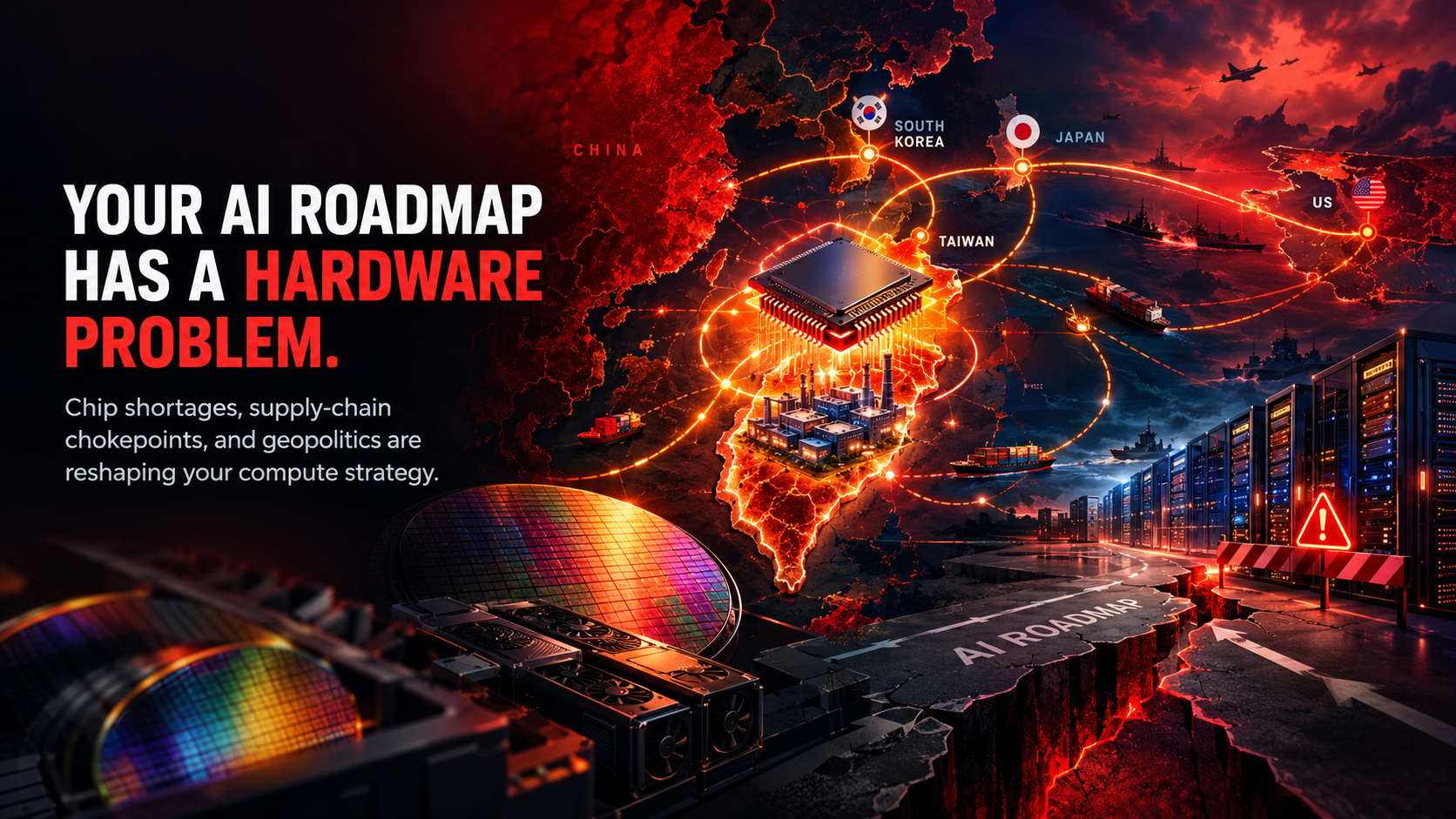
That assumption is now collapsing in real time. The global contest over semiconductor manufacturing has turned AI into something far more physical than a software project. It has become a supply chain discipline, a logistics puzzle, and a geopolitical risk management exercise rolled into one. The companies that internalize this shift early will build roadmaps that survive contact with reality. The ones that do not will keep planning for a world that stopped existing.
A Blockade Measured in Bytes
On August 18, 2020, the destroyer USS Mustin steamed into the northern end of the Taiwan Strait with its five-inch gun aimed southward. Officially, it was a solo mission to reaffirm the right of free passage through international waters. But below the bridge, in a darkened combat information room, sailors watched brightly colored displays powered by microelectronics—the very same kind of silicon the ship had been sent to protect. A few dozen miles off the starboard bow sat TSMC’s Fab 18, often described as the most expensive factory ever built by human hands.
That single image captures something that executive briefings rarely convey. AI is not an ethereal layer of software floating above the economy. It is as physical and as flammable as a naval gun. Every transformer inference, every model training run, every chatbot answer is the end product of an enormously long chain of physical processes: purified sand turned into silicon ingots, ingots sliced into wafers, wafers carved with patterns smaller than a living cell, then diced, packaged, shipped, and assembled into servers that consume megawatts of electricity.
Strategic thinkers in Beijing have long worried about what analysts call the Malacca Dilemma—the idea that China’s energy lifeline passes through a narrow strait controlled by others. But as the authors of the book that documented this era point out, the more modern anxiety is a blockade measured in bytes rather than barrels. When your national AI ambitions depend on fabrication plants located in one small island democracy, and when the machines that build those chips come from a handful of companies in three countries, the chokepoints are no longer about oil tankers. They are about photolithography systems, extreme ultraviolet light sources, and the geographic coordinates of a single clean room.
The phrase that matters now is compute security. For twenty years, enterprise strategy revolved around energy security and data security. The next decade will be defined by who can secure enough computing power at predictable prices, from diversified sources, without exposing their entire roadmap to a single geopolitical event. If your planning assumes an infinite supply of ever-cheaper compute, you are not preparing for a technological future. You are describing a fantasy.
Why Software Dreams Meet Silicon Reality
Strip away the marketing and AI is nothing more than the controlled movement of electrical current. A chip is a grid of millions or billions of transistors—tiny switches that flip between two states, on and off, one and zero. The typhoon of steel that decided the Second World War has been replaced by a typhoon of silicon, and the scale of fabrication required to feed modern AI is genuinely staggering.
Consider the arithmetic of progress. In 1961, the Fairchild Micrologic—one of the first commercial integrated circuits—contained just four transistors. By 2020, the A14 processor inside the iPhone 12 packed 11.8 billion of them. A single seemingly trivial AI action, like asking a model to summarize a paragraph, triggers a coordinated physical effort involving processors built for parallel math, memory chips that store and retrieve data strings, photolithography machines that carve patterns onto wafers with a precision that borders on the supernatural, and electronic design automation software that arranges billions of transistors into working logic.
None of this would be possible without a breakthrough most executives have never heard of: the planar process. In 1959, engineer Jean Hoerni discovered that protecting a transistor with a layer of silicon dioxide made it reliable enough to mass-produce. Before that, computing machines were closer to museum pieces. The ENIAC, completed in 1945, relied on roughly 18,000 vacuum tubes—glowing, fragile, lightbulb-like devices that burned out constantly. Legend has it that moths short-circuited the machine, giving birth to the term debug. The planar process transformed the transistor from a fragile laboratory curiosity into a dependable commodity, and it is the forgotten foundation upon which the entire AI age quietly rests.
The lesson for business leaders is uncomfortable but clear. Every layer of the AI stack, from the model weights to the application interface, ultimately rests on physical switches manufactured in a handful of locations. When strategists talk about moats and differentiation, they rarely pause to consider that their entire competitive position depends on the output of factories they do not own, in countries they do not control, using machines built by a tiny oligopoly.
The Quiet Concentration Nobody Budgeted For
Semiconductor supply chains are defined by a staggering vulnerability that most boardrooms have never formally assessed. During the oil crises of the twentieth century, the world worried that OPEC controlled roughly 40 percent of global oil production. As alarming as that seemed, it pales next to the concentration ratios in modern chips.
Consider three facts. First, Taiwan produces about 37 percent of the world’s new compute capacity every year, and the most advanced processors come from a single building: TSMC’s Fab 18. Second, two Korean companies—Samsung and SK Hynix—produce around 44 percent of the world’s memory chips, the DRAM and NAND that every AI server needs in enormous quantities. Third, the machinery required to make cutting-edge chips comes from just five companies: one Dutch firm, one Japanese firm, and three Californian firms. ASML alone holds an effective 100 percent monopoly on the extreme ultraviolet lithography systems needed for the most advanced nodes. No ASML machine, no cutting-edge AI chip, no modern data center buildout. It is that simple.
This concentration feeds a strategic delusion that is deeply embedded in corporate culture. Executives assume the cloud is a distributed, almost indestructible resource—a notion reinforced by reassuring words like elastic, scalable, and redundant. The reality is that the cloud is a series of fragile hubs sitting on tectonic and geopolitical fault lines. A major earthquake in the wrong place, a blockade of the right strait, or an export control announced on a Friday afternoon could interrupt the world’s supply of advanced compute in a matter of weeks, not years.
It is also worth remembering that this supply chain was never an accident of pure economics. Washington deliberately encouraged the complex, Asia-centered semiconductor ecosystem for decades as a tool to bind Asia into an American-led economic order. Chips were the glue of that system. Now the tool has become a trap: the same interdependence that created unprecedented prosperity has created unprecedented fragility, and the companies building AI strategies on top of it are exposed to decisions made in government offices they cannot influence.
Moore’s Law Was Never Free
For fifty years, the cost of processing a single bit fell by roughly a billionfold. Gordon Moore’s famous observation—that transistor density doubles every couple of years—became less a prediction than a self-fulfilling industrial promise. Entire software industries grew up assuming that hardware would keep getting cheaper, faster, and more abundant forever. When compute is cheap, you can afford to be sloppy. You can prioritize development speed over efficiency, ship bloated code, and train oversized models, because the hardware bill of materials was never the constraint.
That free ride is ending. Modern fabrication plants cost tens of billions of dollars each, and the industry’s migration to two-nanometer-class nodes is mind-bogglingly expensive—so costly that even the wealthiest companies are forming alliances and accepting government subsidies to share the burden. The physics of scaling are also grinding against reality: as transistors approach atomic dimensions, the energy required to switch them and the heat required to cool them become existential design problems rather than afterthoughts.
The strategic implication is profound. Theoretical AI is limited by code; strategic AI is limited by the physical arrangement of atoms. A roadmap that assumes hardware will remain a cheap, neutral, infinitely expandable commodity is built on the economics of the past. The era of pure efficiency, in which every problem was solved by throwing more compute at it, is giving way to an era of resilience, in which the scarce resource is not talent or data but usable computing power delivered at the right place, at the right time, at a defensible price.
Back to the Apollo Era
There is historical precedent for this kind of hardware-first thinking, and it comes from an unlikely place: the moon program. In the 1960s, NASA engineers chose the Apollo Guidance Computer not because it was the most powerful machine available but because it delivered twice the computations at half the weight. As engineer Bob Nease put it, the decision was simply a matter of size and weight. Every gram sent to the moon had to be justified, and that scarcity forced a discipline that modern AI development has largely forgotten.
The industry is now returning to that Apollo-era mindset, and the reason is brutally physical. The bigger-is-better approach to large language models—scaling up parameter counts and hoping intelligence emerges—has collided with the wall of energy consumption and chip scarcity. Training runs that once seemed exotic now consume electricity on the scale of small cities, and the GPUs required for them are allocated months or years in advance. When the hardware itself is the bottleneck, the primary KPI of an AI roadmap must change. The metric that matters now is compute-per-watt: how much useful intelligence can you extract from every joule of energy and every precious silicon die.
The difference between hype-driven and hardware-aware roadmaps is stark. Hype-driven planning fixates on parameter counts, assumes GPU availability is a given, and never asks where a server physically lives. Hardware-aware planning, by contrast, treats model distillation as a first-class strategy—compressing large models into smaller, specialized ones that do the same job for a fraction of the compute. It prioritizes retrieval-augmented generation, which lets companies use smaller models backed by external knowledge rather than gigantic models that memorize everything. And it audits physical dependencies on tier-one fabrication plants, so that a supply disruption does not arrive as a surprise.
This is not a downgrade of ambition. It is a maturation of it. The companies that treat efficiency as a strategic weapon will discover that smaller models, deployed closer to users, running on diversified hardware, can deliver better business outcomes than a single monolithic model that requires a data center the size of a warehouse to serve.
Run the Geopolitical Audit
If there is a single lesson from the past few years of export controls, it is that a blockade can indeed be measured in bytes. When the U.S. Commerce Department placed Huawei on its Entity List, the company discovered—almost overnight—that its entire product line was fatally dependent on foreign-made chips and American-designed electronic design automation software. Product lines vanished. Whole divisions had to be reimagined. The term used inside the industry was technological asphyxiation, and it describes a slow, deliberate cutting off of the air a company needs to breathe.
Every AI strategy now needs a comparable geopolitical audit, and it should be brutally honest. Ask whether your cloud provider builds its proprietary AI accelerators in a single building, and where that building is. Ask whether your compute supply chain depends on a single machine-tool manufacturer—remember that ASML’s monopoly position means the most advanced chips on earth all pass through one company’s technology. Ask whether your in-house AI, which you may describe as sovereign or independent, actually runs on hardware or software that could be subjected to sudden export controls. And ask the uncomfortable logistics question: what is your 48-hour plan if the Taiwan Strait closes to commercial freighters?
The last question sounds alarmist until you realize how dependent the global economy has become on just-in-time delivery of advanced components. Modern supply chains carry almost no buffer inventory, because decades of efficiency optimization taught companies that inventory is waste. The flaw in that logic is now visible: when the supplier is concentrated in one geographic location, the absence of buffer inventory turns a regional disruption into a global emergency. Resilience requires deliberate redundancy, and redundancy costs money—which is exactly why it must be budgeted for now, rather than discovered as an emergency expense later.
Five Moves That Make a Roadmap Resilient
Understanding the problem is useful, but action is what separates resilient organizations from vulnerable ones. Five moves, executed consistently, will substantially harden any AI roadmap against the realities of the chip war.
The first move is to audit physical fab dependencies at both tier-one and tier-two levels. Map your AI stack down to the silicon. Determine which fabrication plants—TSMC, Samsung, Intel, and their partners—actually produce the chips powering your specific cloud instances, and identify where the asphyxiation points sit in your supply chain. This exercise alone often produces surprises: teams discover that their supposedly diversified cloud strategy runs on the same chip, from the same fab, wearing three different brand labels.
The second move is to embrace hardware-software co-optimization in the style of Apple. Apple’s lasting advantage has never been just its designs or its marketing; it is the obsessive integration between software and the specific silicon underneath it. By optimizing models for the underlying architecture—or designing architectures with specific models in mind—organizations can typically reduce raw compute requirements by 30 to 50 percent. That is not a marginal improvement; it is the difference between a roadmap that fits inside the available hardware supply and one that does not.
The third move is to avoid the single-building trap by diversifying compute across geographic and corporate sources. Hedge your exposure by working with providers that are investing in Intel’s domestic expansion in the United States, Samsung’s Korean facilities, and emerging capacity elsewhere. Diversification will not eliminate risk, but it converts a potentially fatal single point of failure into a manageable portfolio of exposures.
The fourth move is to invest in smaller intelligence. Shift research and development budgets toward distilled models and retrieval-augmented architectures. Smaller, specialized models are dramatically easier to port across different hardware tiers during a shortage: when one chip vendor’s supply dries up, a compact model can run on almost anything, while a giant model is chained to the specific accelerators it was trained on. The economics are attractive too—lower compute-unit costs and faster deployment cycles that compound into a permanent competitive advantage.
The fifth move is to treat GPU access the way airlines treat jet fuel. Airlines do not pray for cheap fuel; they hedge it with long-term contracts, because fuel is their largest uncontrollable cost and their operations stop without it. Compute is becoming exactly that kind of commodity for AI-dependent businesses. Negotiate long-term compute contracts with the same rigor, secure reserved capacity with committed suppliers, and build pricing models that survive a volatile and mind-bogglingly expensive market. The companies that lock in capacity today will be the ones shipping products while their competitors wait in queue.
From the Strait to the Boardroom
The USS Mustin sailed through the Taiwan Strait more than five years ago, and its presence there was a reminder that the digital universe rests on a foundation of atoms. The rivalry between the United States and China is increasingly being decided by computing power—not merely by who writes the best code, but by who can control the movement of electrons across slabs of silicon with the most precision, at the largest scale, under the most reliable conditions.
In the age of AI, the most important code is not the software in your repository. It is the physical arrangement of transistors on a wafer—a pattern decided years ago, in a clean room on the other side of the planet, by machines that only a handful of companies can build. Every enterprise roadmap, regardless of industry, now runs through that geography of silicon.
The executives who internalize this will ask different questions in their next strategy review. They will ask where their compute comes from, what happens if it stops, and how much intelligence they can extract from every watt. They will treat hardware diversity as a governance issue and efficiency as a strategic weapon. And they will build roadmaps that acknowledge the world as it actually is: constrained, concentrated, and contested.
For everyone else, the roadmap is not a strategy. It is a hope—and hope is a terrible planning tool when the stakes are measured in silicon.