Somewhere in the last few years a strange ritual took hold in corporate boardrooms. A leadership team stares at an aging, paper-heavy, email-choked process. Someone proposes AI. Six months later there is a chat window in the corner of an interface nobody redesigned, an invoice from a vendor, and a slide deck announcing transformation. The process behind that chat window is exactly what it was before: the same handoffs, the same spreadsheets, the same approval chains, the same queue of people waiting on each other. The company did not transform. It taught an inefficient process to talk.
This is the most expensive misunderstanding in modern business, and it is not a technology problem. It is a category error. Leaders are buying an interface when what they need is an architecture. The chat window is the visible tip of the iceberg; the operating model underneath — who decides what, which data is trusted, where value physically stops and waits for a human — remains untouched. And the operating model is where all the money actually lives.
What follows is not a tour of AI tools. It is an argument about where advantage is actually built, why so many well-funded programs produce nothing but overhead, and what the companies that got it right did differently when nobody was watching.
The Reassuring Feeling of Doing Something
There is a psychological reason the chatbot era arrived so fast. Attaching a conversational layer is cheap, visible, and demo-able. It photographs well. It gives executives something to point at during an earnings call. It also requires no political capital, because it asks no department to give up authority, no manager to surrender a decision right, and no system owner to expose their data to the rest of the company.
Genuine transformation does the opposite. It asks the operations director to stop approving routine exceptions. It asks finance to accept a model’s credit call without a human signature. It asks the marketing team to hand over campaign budgets to an automated bidding system that it does not fully understand. It asks IT to break a monolith that took a decade to build. Every one of those requests is a fight. A chatbot is not a fight. That is precisely why it won.
The result is a familiar landscape: enterprises full of pilots, thin on production systems, and strangely confident. Pilot success rates look excellent because pilots are scoped to the one place where the surrounding process has already been cleaned up by hand. Scale them and they collapse into the same friction the rest of the company runs on. The bottleneck was never the task. The bottleneck is everything around the task.
Weak AI Is Already Running Your Competitors
Another quiet misunderstanding keeps leaders waiting. Many assume that AI must reach something like general intelligence — a machine that reasons broadly, understands context, and thinks like a person — before it can restructure an industry. That framing has produced a decade of patient waiting, and the waiting has been expensive.
The competition being lost today is not being lost to thinking machines. It is being lost to narrow systems that do one unglamorous thing with relentless consistency: ranking a feed, scoring a loan, routing a delivery, setting a price, flagging a transaction, matching a driver to a rider. These systems do not need to understand anything. They need to be fast, cheap, statistically reliable, and capable of running ten million times a day without fatigue.
Satya Nadella’s framing captures this well: AI as the runtime. That word is precise. A runtime is not an application you visit; it is the environment every application executes inside. When AI becomes the runtime of a business, software and statistical models stop being assistants and start occupying the critical path where value is created and delivered. The company’s output becomes a function of its models plus its data, not a function of how many people can be hired and trained quickly enough.
Imperfect is fine in this world. A recommendation engine that is right sixty percent of the time beats a merchandiser who is right fifty-five percent of the time and works forty hours a week. A fraud model with a two percent false positive rate is not a compromise; it is a different economic category than a team of auditors sampling transactions after the money has already left. Narrowness is not a limitation to be waited out. Narrowness is the entire point.
The Next Rembrandt Proves the Wrong Thing
In 2016 an advertising agency and a technology partner produced a painting that looked like a lost Rembrandt, three and a half centuries after the artist died. A multidisciplinary team analyzed hundreds of thousands of high-resolution scans of his known works, a dataset of over one hundred and forty million pixels, and extracted the visual grammar: the subject should be a man between thirty and forty, with facial hair, a dark coat, a white collar, a hat, facing right. Algorithms assembled the composition. A specialized printer laid down thirteen layers of UV-curable ink to reproduce the physical relief of paint on canvas.
It was a stunning demonstration and it proved something narrower than most people took from it. It proved that machine learning can simulate an analog output convincingly. It did not prove that an organization had been rebuilt. The project was a technical flourish with a famous brand attached — brilliant marketing, negligible operating consequence. The value chain that produced paintings was not restructured; it was cosplayed.
That distinction is the one that matters when a leadership team studies the case and concludes that their industry is next because AI can now imitate its outputs. Simulation is a demo. Re-architecture is a business. You can print a Rembrandt that fools a curator and still lose the market to someone who rebuilt distribution.
Adoption, Automation, Transformation: Three Rooms With Similar Names
Executives routinely conflate three very different positions on the technology curve, and the confusion is expensive because each one produces a different ceiling. Diagnosing which room you are actually standing in is the first useful act of strategy.
- Adoption — buying licenses and giving people access. Individual productivity improves at the margins. The operating model, the data architecture, and the workflow paths are identical to last year. Nothing compounds.
- Automation — digitizing individual tasks inside functional silos. Parts of the process get faster, but the silos, the handoffs, and the human approvals remain. You have accelerated steps inside a workflow that is still fundamentally sequential and manual.
- Transformation — re-architecting the operating model itself: unified data, software on the critical path, decision logic expressed as code, and organizational structure rebuilt around modular interfaces rather than departmental territory.
The ceilings differ enormously. Adoption is bounded by how fast individuals can type. Automation is bounded by the workflow it sits inside — including every manager who must still approve, reconcile, or sign. Transformation is bounded by capital and by the availability of clean data, which is to say it scales in a way traditional management cannot match.
The trap is that automation looks like transformation from a distance. A department automates invoice parsing and reports a thirty percent efficiency gain. Leadership reads the number and believes the machine has arrived. Meanwhile the invoice still travels through four systems, three inboxes, and one manager’s Tuesday afternoon. The thirty percent gain was real — and it was also thirty percent of a cost that should have been eliminated entirely.
Kodak Did Not Lose to a Better Camera
The standard Kodak story is that the company invented the digital camera in 1975 and then failed to embrace it. That version is memorable and mostly beside the point. Kodak did embrace digital capture. What it did was treat digital as a component swap — replace chemical film with a sensor, keep everything else. Keep the manufacturing, keep the retail distribution, keep the high-margin printing business, keep the assumption that photographs are physical objects customers pay repeatedly to produce.
Digital capture changed something deeper than the camera. It turned a photograph into a file. Files have different economics: near-zero cost to copy, near-zero cost to store, near-zero cost to distribute at planetary scale. Once photographs became data, they stopped being a product and became a feedstock. Platforms built around that feedstock — feeds, tagging, recognition, behavioral inference — constructed operating models with no linear relationship between users and cost, and a compounding relationship between users and model quality.
Kodak’s value chain was linear and cost-bound at every step. Its eventual competitors operated networks with negligible marginal cost and continuous learning. That collision was not a fair fight, and it was not a failure of imagination about cameras. It was a failure to notice that the unit of competition had changed from the product to the operating model around the product.
This pattern repeats across industries that feel nothing alike: publishing, taxi dispatch, insurance underwriting, retail banking, logistics brokerage. The incumbent improves the artifact. The entrant rebuilds the machine that produces the artifact, then out-competes on a cost curve the incumbent cannot follow because following it means dismantling itself.
When Prediction Gets Cheap, Judgment Gets Valuable
The cleanest economic framing of AI is that it collapses the cost of prediction. Prediction here means something mundane and enormous: using existing data to produce information about something missing, present, or not yet true. What will this customer buy? Will this borrower repay? Which route will arrive on time? Which transaction is fraudulent? Which machine will fail next week?
When the price of a fundamental input falls by orders of magnitude, it does not get used a little more. It gets used everywhere, and it restructures the surrounding business. Static price lists give way to continuous pricing. Annual credit reviews give way to real-time scoring. Quarterly audits give way to anomaly detection running on every transaction. Functions that existed to produce predictions — underwriting desks, forecasting teams, manual reconciliation — lose their reason for being, not because they performed badly but because the input they produced became almost free.
The complement is what everyone misses. When prediction becomes abundant, the scarce input becomes judgment: choosing which objective function to optimize, deciding what trade-offs are acceptable, defining the boundaries the system may not cross, and recognizing when the metric itself has become the problem. Algorithms produce probabilities. Humans decide which probabilities matter, at what cost, within what ethical perimeter. A company with world-class models and no clear judgment about what it is optimizing will optimize something it regrets, very efficiently.
The Critical Path Is the Whole Argument
If you want one diagnostic to bring to your next operating review, bring this question: where exactly does value wait for a human? Every business has a critical path — the sequence of steps that must complete for a customer to receive value. In traditional operations, humans sit inside that sequence, and their presence imposes three permanent taxes: latency, variance, and coordination cost.
Latency, because people work in hours and days while software works in milliseconds. Variance, because two employees handling identical cases produce different outcomes, which forces reconciliation overhead. Coordination cost, because every handoff between people requires meetings, tickets, and status updates that produce no customer value whatsoever. None of these are the fault of employees. They are properties of an architecture.
Digital operating models move humans off that sequence and onto its edge. The human roles that remain are higher-leverage and fewer in number:
- System designers — building and refining the environments, interfaces, and workflows that everything else runs inside.
- Domain experts — defining the features, parameters, and objective functions that give models their context and their limits.
- Ethical and risk guardians — auditing outputs for bias, privacy exposure, security weakness, and alignment with commitments the company has made publicly.
- Exception handlers — resolving the genuinely novel cases that fall outside confidence thresholds, and feeding what they learn back into the system.
Note what this is not. It is not a headcount reduction story, and framing it that way is the fastest way to lose the organization. It is a relocation story. The same people, moved from repetitive execution to design and oversight, which is intellectually harder and typically more valuable. Companies that lead with the headcount narrative get resistance; companies that lead with the relocation narrative get volunteers.
Three Hundred People, Five Million Borrowers
The starkest illustration of an operating model gap in financial services is a comparison worth sitting with. One digital-native lender serves more than five million small and micro businesses with roughly three hundred employees. A large traditional bank serves tens of millions of customers with roughly two hundred thousand employees. The cost to process a single loan differs by three orders of magnitude, and the time to decision differs by three orders of magnitude too: one second against days or weeks.
The difference is not talent. It is where the data comes from and where the human sits. A traditional bank underwriting a small business loan relies on periodic, static evidence: tax filings, audited statements, a credit bureau pull, a relationship manager’s impressions. The picture is months old by the time a decision is made, and assembling it consumes skilled labor.
The digital-native model datafies daily life instead. It continuously ingests behavior from its own consumer ecosystem — relocation patterns, utility payments, peer transfers, savings activity. It ingests merchant-side signals from a sibling e-commerce platform: transaction volume, return rates, inventory turnover, fulfillment reliability. It ingests public records and government registries, plus partner network signals from travel, mobility, and offline retail. When an application arrives, thousands of automated risk strategies evaluate it in real time against a picture that updated this morning.
Two things follow, and only one of them is about cost. The obvious one is unit economics that make lending to a shop with modest revenue profitable at all. The less obvious one is that risk assessment improves continuously with every transaction the ecosystem processes, so the model gets better as the business grows, without hiring. That is the compounding loop traditional institutions cannot replicate by buying the same software, because the software is not the asset. The data flow is.
A Business Model Is a Promise; an Operating Model Is the Machine
Strategy conversations get muddy because two different things share the same vocabulary. A business model is the promise: what value you create for whom, and how you capture a portion of it. An operating model is the machinery that delivers on that promise: systems, processes, data pipelines, software engines, decision rules, and how talent is organized around them.
Digital strategy failures are almost never failures of the promise. They are misalignment. A beautifully designed digital business model sitting on a siloed, analog operating model hits a ceiling fast, and the ceiling feels like market resistance, cost inflation, or customer dissatisfaction. In truth it is the machine straining against a promise it cannot physically deliver.
The alignment question is blunt and useful: for every promise in the strategy, which part of the machine delivers it, and does that part touch a human in the middle? If the answer is yes for the promise you consider your differentiator, you do not yet have a differentiator. You have an ambition with a queue attached to it.
Breaking the Old Trade-Offs: Scale, Scope, and Learning
Traditional industrial management is built on trade-offs that felt like physics. Grow bigger and coordination costs rise; expand into adjacent categories and complexity compounds; institutional knowledge erodes as people leave. Digital operating models weaken all three constraints at once, which is why incumbents find them so disorienting.
Scale stops being linear. Software infrastructure and model inference scale with volume without a proportional increase in human coordination. Serving the next million customers does not require the next thousand managers, because there is no manager in the path.
Scope becomes modular. Adjacent categories can be reached through interfaces rather than acquisitions. A messaging platform becomes a payments rail, then a wealth product, then a mobility marketplace, then a healthcare scheduler, each addition using the same identity, distribution, and data foundation. Each expansion is cheap because the foundation is shared.
Learning stops depending on memory. Human learning is bounded by individual cognition, attention, and turnover — when the expert leaves, capability leaves with them. Digital learning is institutional by construction: every transaction produces training signal, and the model’s competence persists and compounds regardless of who is employed this quarter.
Those three properties are the actual prize. Not the chatbot. The chatbot is what you get when you want the prize without paying for it.
Conway’s Law, and What Amazon Was Actually Fixing in 2002
There is a reason transformation programs stall at the org chart rather than at the technology. Conway’s Law observes that a system’s architecture comes to mirror the communication structure of the organization that builds it. Isolate your people in functional silos, and your software becomes siloed and monolithic — not by incompetence, but by information flow. Teams that cannot talk to each other cannot build systems that talk to each other.
Amazon hit exactly this wall. By 2002 its monolithic codebase was buckling under expansion into new categories that operated as disconnected units, with releases stalling and database dependencies producing outages. The fix was not a framework upgrade. It was a mandate with a termination clause: all teams must expose their data and functionality through service interfaces; teams communicate exclusively through those interfaces; no direct database reads, no shared memory, no back doors; every interface must be designed as though it would be externalized to outside developers.
Read that mandate as organizational design rather than engineering policy and it becomes obvious what it did. By forcing clean interfaces between services, it forced clean boundaries between teams. Dependencies collapsed. Small autonomous teams could ship without a coordination meeting. Data became addressable, which is the precondition for any centralized model training to exist at all. Everything Amazon later built on top of that — its cloud business, its voice platform, its recommendation engines — required that substrate to exist first.
Most companies attempt the reverse order. They buy models, then discover their data is unaddressable, then discover their teams cannot cooperate, then conclude AI is oversold. The substrate was the work. It always was.
Anatomy of an AI Factory
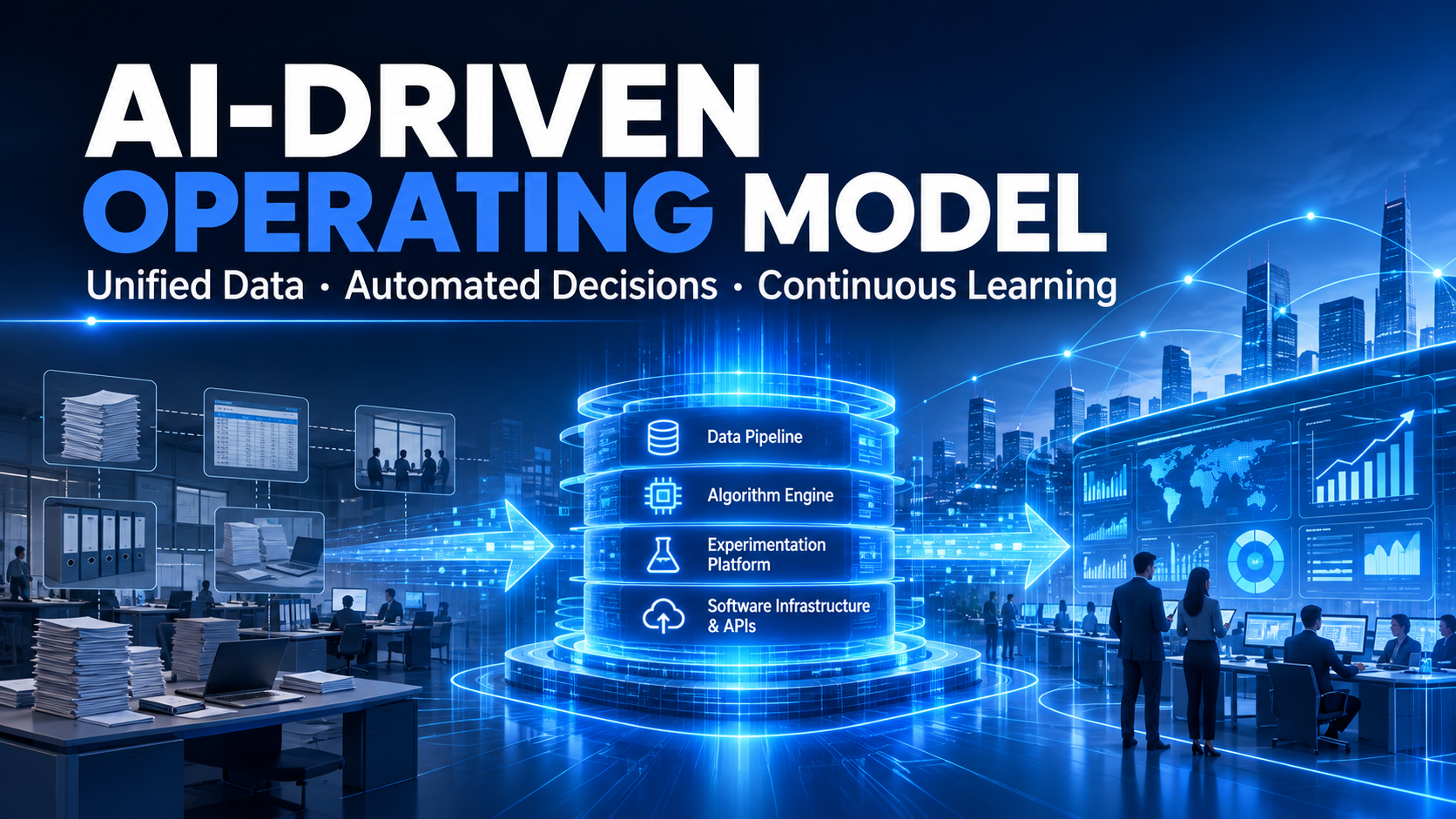
When the pieces are assembled correctly, what emerges is best understood as a factory — an industrial process that converts raw operational activity into decisions, continuously and without heroics. Four components, none of them glamorous.
The data pipeline. Ingestion, cleaning, normalization, integration, and securing of operational data from internal transactions, partners, and edge devices. Its job is to turn noisy activity into standardized assets a model can actually learn from. This is where most programs silently die, because it is unglamorous, expensive, and takes years rather than quarters.
The algorithm development engine. The models themselves, drawn from three families. Supervised learning maps labeled inputs to known outcomes — churn prediction, fraud detection, demand forecasting. Unsupervised learning finds structure nobody labeled — taste clusters, anomaly groups, natural segments. Reinforcement learning learns policies by acting and observing reward, including multi-armed bandit approaches that manage the trade-off between exploring new options and exploiting proven ones, which is precisely what real-time pricing, ad allocation, and recommendation need.
The experimentation platform. The discipline that separates a model that works from a model that merely correlates. Automated randomized controlled trials, run continuously, comparing treatment against control before broad rollout. Without this, organizations ship changes that look like wins in dashboards and produce nothing in revenue, and they have no way to tell the difference.
Infrastructure and interfaces. The modular plumbing that exposes data and model outputs safely across the company through standardized, catalogued, secured APIs — so feature teams and external partners can build quickly without reaching into production databases. This is the component Bezos’s mandate was really about.
Factories are judged on throughput and reliability, not on cleverness. An AI factory with mediocre models and excellent pipelines will beat brilliant models with no pipeline every single quarter, because the mediocre one improves automatically and the brilliant one never reaches production.
Where Human Work Actually Goes
Two industries make the relocation concrete. Online grocery fulfillment is among the least forgiving businesses in retail: thin margins, perishable inventory, thousands of unpredictable SKUs, and customers who expect narrow delivery windows. The winning model turned the warehouse into a machine — dense grids traversed by hundreds of coordinated bots, inventory placed by algorithm, picking sequenced by algorithm.
The interesting part is not the robots. It is that the system predicts demand and farm yield days ahead, ordering perishable produce to arrive at the fulfillment center hours before the customer’s delivery slot, which nearly eliminates spoilage — a cost that traditional grocers treat as an unavoidable constant. Routing engines recalculate thousands of variables per second against weather and traffic to protect on-time rates. Humans remain, deliberately, off the critical path: handling fragile or irregular produce that machines still do poorly, and stepping in when the exception is genuinely exceptional.
Connected fitness shows the same pattern in a domain with no physical logistics at all. A traditional studio class is capped at thirty or forty riders per instructor, forever, because the instructor is a person in a room. Decoupling the class from the room turns one instructor-hour into a product with effectively unlimited capacity, and turns the bike into a data-collecting terminal that feeds content decisions, retention models, and workout design. The hardware was never the business. The operating model around the hardware was.
In both cases the pattern repeats: the physical artifact improves only modestly, while the economics change completely, because the constraint being removed was organizational rather than material.
Guardrails Are Architecture, Not Posters
None of this is safe by default. A system that decides at scale also errs at scale, and the failure modes are not hypothetical: biased lending, opaque denials, privacy exposure through correlation, feedback loops that amplify their own bad assumptions, and the quiet drift of a model trained on last year’s world still deciding this year’s cases.
Which is why governance has to be built into the machine rather than announced about it. Concretely, that means documented data lineage so anyone can trace a decision back to its inputs; versioned models with reproducible evaluation before promotion; confidence thresholds above which the system acts and below which it escalates to a human; monitored drift with automatic rollback; and audit trails that survive an external regulator’s scrutiny without a six-week excavation project.
Most organizations discover this requirement at the worst possible moment — after a model has been in production long enough to have consequences and before anyone has thought about how to explain it. Building the guardrails alongside the factory is not overhead. It is the difference between a system you can scale and a system you have to switch off.
The Choice That Will Not Stay Open
There is a comfortable middle position that many leadership teams are currently occupying: keep the legacy operating model, add AI utilities on top, and describe the result as a transformation journey. The position is comfortable because it is cheap in the short term and politically safe. It is also temporary, because it protects nothing. If your data is fragmented across silos, if human labor sits on the critical path of routine execution, and if decisions still route through hierarchy by default, you have not gained an advantage. You have added recurring cost to a structure that was already leaking.
The alternative is unglamorous and slower to demo. Unify the data. Move humans off the execution path and into design, expertise, and oversight. Replace approvals with thresholds, and meetings with interfaces. Publish your capabilities as APIs so the next capability costs a fraction of the last one. Build the experimentation loop that tells you honestly whether any of it worked. Then, and only then, the models have something to run on.
The reason this is urgent rather than merely important is the shape of the collision. When a digital operating model enters a traditional industry, it does not compete on the incumbents’ terms. It brings near-zero marginal cost, multi-sided reach, and compounding data loops against an opponent whose every increment of growth requires another layer of management. Kodak did not lose to a camera company, and the next incumbent to fall will not lose to a better version of itself. It will lose to a machine it never built, in a fight it never noticed starting.
So the question worth carrying into the next planning cycle is not which AI tool to buy. It is simpler and much less comfortable: if someone rebuilt your company today around data, software, and automated decisions, what would still be standing? Everything that would not be standing is your transformation roadmap — and no amount of conversational interface will substitute for the work of actually building it.