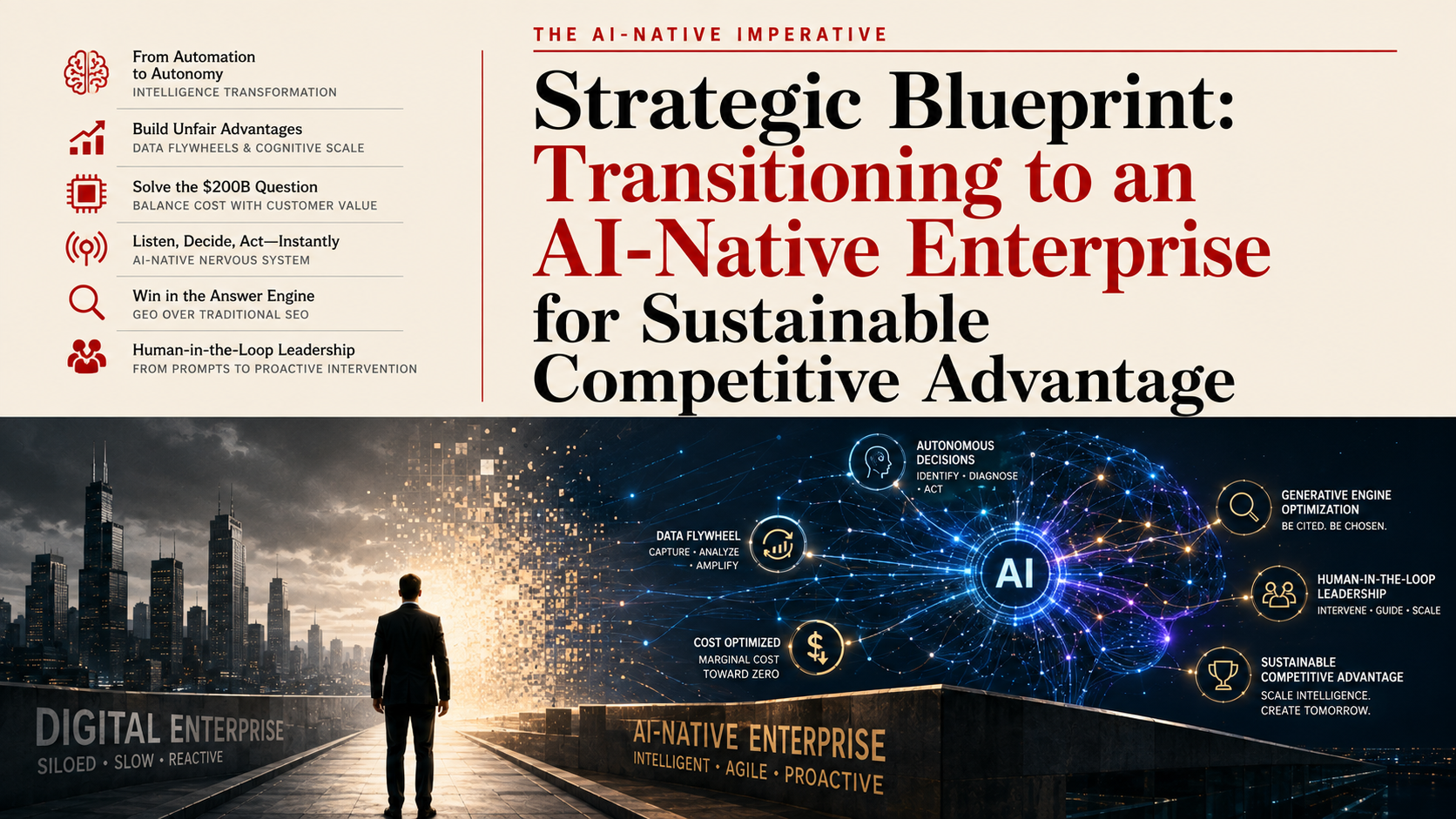
For the better part of a decade, “digital transformation” was the most reliable phrase in boardroom vocabulary. It promised that paper would become pixels: invoices scanned into archives, filing cabinets emptied into shared drives, and sales pipelines lifted into cloud CRMs. Those projects delivered genuine gains, but they belonged to an earlier contest. The ground beneath them has shifted, and companies still playing that older game are competing against a ruleset that no longer applies.
What has replaced it is a transition far more consequential: from digitizing how work is recorded to fundamentally changing who — or what — performs the work itself. Speed-to-market cycles have collapsed at every level, from product releases to geopolitics. When a frontier AI model ships, the strategic shock now registers in days, not years; regulators and competitors alike treat each new capability milestone as a major event. In this environment, incremental efficiency is no longer a strategy. It is a slow way to become irrelevant.
The Era of Intelligence Transformation
Intelligence transformation is not digital transformation with better marketing. Digital transformation made existing processes faster and cheaper by encoding them in software. Intelligence transformation rewires the organization around machines that can sense, reason, decide, and act on their own. The difference is the difference between a calculator and an analyst: one amplifies a known procedure, the other handles the open-ended judgment that used to require senior people.
This is why the shift matters at the level of survival rather than convenience. We now live inside what strategists call MAX change: change that is Massive, Accelerating, and Exponential. Technology cycles no longer move in comfortable ten-year arcs where leaders can watch, learn, and adopt late without paying a serious price. Capabilities now compound so quickly that a two-year delay in architectural decisions can leave a company structurally behind competitors that started the same journey at the same time.
For leadership, the practical consequence is a pivot in vocabulary and intent: from “automated” digital systems to “autonomous” AI-native architectures. Automation executes a fixed playbook reliably. Autonomy writes new plays when the situation changes. That distinction, subtle as it sounds, is the entire ballgame.
Automated and Autonomous: Two Different Species of Software
It is tempting to treat autonomous AI as a smoother version of the robotic process automation (RPA) that many firms already run. The comparison is misleading. RPA automates a rule; AI-native systems govern a business outcome.
- Decision-making: Automated systems are rules-based and stall at exceptions, waiting for a human trigger. AI-native systems are generative: they identify a problem, diagnose its cause, and implement a fix without being walked through it step by step.
- Scalability: Automation scales linearly and grinds to a halt as script complexity grows. Agentic AI scales exponentially, because expertise — not headcount — is the thing being multiplied.
- Cost-to-serve: Automated operations carry fixed software and labor costs that deliver only incremental savings. Autonomous operations push the marginal cost of intelligence toward zero, which changes the unit economics of almost every service business.
- Strategic agility: Automation is tactical, optimizing movement along existing paths. Autonomy is transformative, enabling step-change entry into markets that were previously out of reach.
There is a human consequence buried in this comparison that leaders rarely want to discuss. As the cost of intelligence collapses, the classic “T-shaped” professional — deep in one discipline, broad enough to collaborate across others — loses the automatic premium the market once paid for depth alone. When models can draft contracts, review code, and analyze markets at near-zero marginal cost, deep expertise stops being a moat and starts being a commodity input. The uncomfortable implication is not that experts vanish; it is that their value shifts to judgment, context, and orchestration, and organizations must redesign roles around that reality before their competitors do.
Why the Economics Suddenly Favor Intelligence
The strategic case for this shift is often framed in technology terms, but the real argument is arithmetic. Traditional software attacks a global market of roughly $400 billion — the budgets companies set aside for applications, licenses, and the systems that support workers. AI-native systems point at something far larger: the $1.3 trillion US labor market alone, the wages paid for work that intelligence can now perform or multiply.
That is the crucial reframing. Conventional software sells tools to people who do work. AI-native systems sell the capacity to do the work itself, which is why their addressable market is an order of magnitude larger. When a vendor automates a spreadsheet task, the customer saves a few hours a week. When a system absorbs an entire workflow — qualifying leads, drafting proposals, negotiating standard terms, answering customer questions — the customer is no longer buying a tool; they are buying back human capacity. Different product, different price point, different competitive dynamic.
This is also why the transition cannot be delegated to the IT department as a technology project. It changes the labor model, the margin structure, and the definition of a product. It is a business-model decision that happens to run on software.
The Unfair Advantage Is Structural, Not Tactical
The phrase “unfair advantage” gets thrown around loosely, usually to describe a clever pricing page or a data set the company happens to own. In AI-native organizations, the unfair advantage is engineered into the structure of the firm, and it is rooted in the democratization of expertise.
The most cited proof of what this unlocks comes from Matthew Griffin, a former IBM executive who applied these principles to build a business unit worth billions with a team of only three people. The unit grew sales from $2 million to $350 million — an increase of roughly 16,000% — while legacy competitors with thousands of employees, including HP and Atos, were out-hustled on their own turf. The team did not work longer hours than the incumbents. They worked with amplification: AI systems gave three people the cognitive reach of a much larger organization, letting them move faster on more fronts than rivals who had to coordinate hundreds of humans for every decision.
Two lessons from that story travel well. First, the advantage compounds over time: every win produces data that trains the next cycle. Second, the advantage is architectural: it lives in how the firm captures knowledge, circulates it, and acts on it, not in any single heroic employee. A competitor can copy a feature or match a price. Copying an organizational nervous system takes years, which is precisely why it is unfair.
The Data Flywheel: Knowledge That Circulates by Itself
The cornerstone of this structural advantage is what strategists call the data flywheel — a self-reinforcing loop in which information circulates autonomously instead of being carried from person to person by hand. In Japanese business thinking there is a phrase for the ideal state: 知の回遊, knowledge circulation, the sense of insight moving through an organization the way water moves through a living system rather than sitting in silos.
The flywheel has three motions, and all three must run continuously for it to spin up:
- Ingestion: Real-time capture of every communication, market signal, and internal log — sales calls, support tickets, deal-room chatter, pricing changes, competitor moves. Nothing is too small to record, because small signals become trend lines when aggregated.
- Analysis: Immediate processing of that stream to surface intent and buying signals that human teams miss. A customer who asks three pricing questions in one week is announcing something; so is an executive whose tone shifts in an email thread. The analysis layer turns noise into a queue of opportunities ranked by readiness.
- Action: Agentic AI triggers autonomous responses — a prototype sent for review, a tailored outreach sequence, a proposal drafted around the prospect’s stated priorities — before a bureaucratic competitor has even scheduled its internal kickoff meeting.
The flywheel is powerful because it compounds in both directions. More data makes analysis sharper, sharper analysis produces better actions, better actions win more deals, and every deal generates fresh data. Firms that capture their success patterns — not just their numbers — build a machine that gets smarter with each quarter. Firms that leave knowledge in the heads of employees who eventually leave are, by contrast, running a leaky bucket in a market that rewards accumulation.
The Thousand-Times Workforce: Small Teams at Incumbent Scale
Agentic AI collapses one of the oldest assumptions in business: that organizational capacity scales with headcount. By combining what some architects call SQ (social intelligence), EQ (emotional intelligence), and AQ (action intelligence), a new generation of agents can sense context, read the human dynamics of a deal, and act on both — around the clock, without fatigue, and with access to more institutional knowledge than any single person could hold.
The consequences show up in market data faster than most executives expect. When Anthropic released Claude, the market reaction was not confined to AI stocks: roughly a fifth of the value of major law firms evaporated in short order, because investors could see that analysis-heavy legal work was about to be radically re-priced. That is what strategic amplification looks like from the outside — not the replacement of one worker by one machine, but the re-rating of an entire profession’s economics overnight.
The framing matters internally as well. The goal is not to shrink teams to zero but to amplify a small team into a global force. A three-person startup with agentic support can mount the kind of multi-channel, always-on effort that once required a hundred-person marketing and sales operation. The scarce resource in such a firm is no longer labor; it is judgment about which agents to deploy, toward which outcomes, with what authority.
Facing the Two-Hundred-Billion-Dollar Question
None of this ambition survives contact with bad unit economics, which brings us to the most uncomfortable number in the industry: the gap that Sequoia Capital famously labeled the $200 billion hole. The math is brutal and worth sitting with. For every dollar spent on a GPU, roughly another dollar is consumed in energy to run it. If the industry collectively invests $100 billion in data centers, it needs $200 billion in lifetime revenue at a 50% margin just to break even on the infrastructure — before a single dollar of profit appears.
Investing in compute without a clear, defensible path to end-customer value is not a growth strategy; it is a capital incinerator. This is the discipline that separates serious AI-native enterprises from the crowd buying GPUs because everyone else is. The question executives must ask is not “how much compute do we need?” but “what customer outcome will this compute produce, and what is that outcome worth?” Infrastructure is a cost center until someone attaches it to a revenue line.
Three Strategies That Turn Compute Into Customer Value
Closing the gap between infrastructure spend and customer value requires shifting the conversation from models and megawatts to the value created at the edge. Three strategies do most of the heavy lifting:
- Marginal cost reduction: Use AI to produce software, engineering prototypes, rocket-engine designs, or vaccine candidates in hours instead of quarters. When the cost of creating falls toward zero, the innovation pipeline stops being gated by budget cycles and starts being gated only by judgment about what to build next.
- Inference-driven sales: Use AI to analyze deal psychology and buying intent in real time rather than at quarterly forecast reviews. Deals die in the gap between intent and response, and the numbers suggest that gap claims roughly 30% of otherwise winnable opportunities. Reading intent in the moment — and acting on it in the same moment — recovers deals that would have gone cold.
- Hyper-personalization: Deliver individualized messaging to every decision-maker at scale, not segments of a thousand. The payoff is measurable: visitors arriving from AI-powered search convert at rates up to 5.1 times higher than traditional search traffic, because they arrive with intent already shaped by a conversational assistant rather than with a vague keyword.
Each of these strategies has the same shape: take a capability that used to be scarce and expensive — design, diagnosis, persuasion, personalization — and make it abundant and cheap. Firms that do this re-price their own cost-to-serve, which is a competitive weapon that does not show up on a feature comparison table.
Listening Systems: The Corporate Nervous System
To act on opportunity in real time, an organization must first be able to sense it. AI-native firms therefore invest in what are increasingly called listening systems: continuous scanners that monitor public and private data for signals of market intent — a procurement memo, a leadership change, a product complaint, a strategic pivot announced in an earnings call.
One frequently cited example comes from IBM, which used a listening system to detect that a Walmart executive had publicly expressed skepticism about public cloud. Most traditional sellers, seeing Walmart as a cloud prospect, would have charged in pitching public cloud and lost the room in the first five minutes. IBM instead sensed the signal, read the intent beneath it, and pivoted to pitch a hybrid and private cloud solution tailored to exactly what the executive had said they wanted. The result was a deal won precisely because the seller listened before it spoke.
The lesson generalizes. In a digital organization, market intelligence is a report that arrives monthly, if at all. In an AI-native organization, market intelligence is a nervous system — always on, always filtering, always routing the relevant signal to the relevant responder. The company becomes less like a hierarchy and more like a living organism that reacts before the threat or opportunity has finished appearing.
Closing the Loop Between Intent and Response
Sensing intent only creates value if the organization can respond while the intent is still warm. Traditional sales cycles leak value at exactly this point: the gap between a customer’s peak interest and the seller’s follow-up. Days pass, the window closes, the deal stalls.
AI-native systems compress that loop until it almost disappears. The mechanics look like this: an agent identifies a buying signal — a customer photographing a slide during a demo, an enthusiastic tone shift in an email, a second stakeholder added to the thread. A content engine immediately generates a personalized proposal or deal scenario built on psychological mirroring, matching the customer’s own language, priorities, and objections. Legal review, historically the slowest part of any deal, is handled by AI agents that vet and return contracts in minutes instead of weeks. The proposal lands while the customer’s intent is at its peak, and the deal closes in the warmth of the moment rather than the chill of a follow-up email three weeks later.
None of this removes humans from the loop; it removes the lag from the loop. People still make the strategic calls and own the relationships. But the operational latency that once cost 30% of winnable deals is engineered out of the system, and that alone changes what a sales organization can promise its pipeline.
The Death of the Blue Link: Why GEO Replaces SEO
While internal operations accelerate, the external contest for visibility has migrated to a new battlefield. The blue link — the ranked list of search results that defined commercial attention for two decades — is dying. Being number one on Google means little if your brand is invisible to ChatGPT, Perplexity, and Gemini, because a growing share of buyers never click a search result at all. They ask an assistant, and the assistant answers.
The shift is measurable. Traditional search click-through rates have dropped by roughly 38% under the weight of “zero-click” AI summaries that answer the question on the results page itself. But the migration carries a massive carrot with it: visitors referred by AI search engines convert at 4.4 to 5.1 times the rate of traditional search traffic. The people arriving through AI assistants are not browsing; they are pre-qualified, mid-decision, and asking for exactly what the assistant recommended.
Optimizing for this new reality is called generative engine optimization (GEO), and it is not SEO with a new label:
- Primary target: SEO pursues crawlers and ranking algorithms; GEO pursues retrieval-augmented generation (RAG), the mechanism assistants use to pull facts from source material when composing an answer.
- Metric of success: SEO chases backlinks and domain authority; GEO chases citability, statistics, and accuracy — the properties that make an assistant willing to name your source.
- Retrieval logic: SEO optimizes page titles for a crawl-and-index model; GEO optimizes specific content chunks for synthesis, because an assistant quotes your paragraph, not your homepage.
The practical consequence is that corporate content now has two audiences: the humans who read it and the machines that decide whether to recommend it. Content strategies built only for the first audience are already losing the second — and the second audience controls an increasing share of the first.
Writing Content That Machines Can Cite
To be cited by AI agents, content must be machine-legible, which is a specific and learnable discipline. The emerging standard is answer-first writing, sometimes called BLUF — bottom line up front — applied to every asset the company publishes.
Three habits matter most. First, lead with quotable definition sentences: structures of the form “X is Y” in the opening paragraph give assistants easy-to-lift definitions they can drop into an answer without paraphrase risk. Second, load the piece with cited statistics: research suggests that adding numerical claims with clear attributions — academic studies, industry reports — increases AI citation rates by around 40%, because assistants prefer numbers they can trace to a source. Third, structure for extraction: use a clean H2 and H3 hierarchy, and keep paragraphs between one and five sentences long so that any individual chunk still makes sense when pulled out of the page and stitched into an assistant’s answer.
This is a cultural change as much as an editorial one. Most marketing teams still write for the featured snippet era: punchy, keyword-stuffed, optimized for a headline. The GEO era rewards a different virtue: being the clearest, most defensible source on a topic, because clarity and defensibility are exactly what an assistant is programmed to prefer.
From the Prompt Box to Proactive Intervention
Becoming AI-native is not accomplished by buying licenses and telling employees to use a chatbot. The binding constraint is organizational: what authority are agents allowed to exercise, and how do humans supervise decisions without becoming the bottleneck?
The useful mental model is a hierarchy of agency, graded by how much of the work loop a person or system can complete before needing help. Low agency means identifying a problem and asking what to do. Mid-level agency means investigating and proposing options. The top tier — S-tier agency, in the current shorthand — means identifying, researching, and diagnosing a problem, implementing a solution, and only seeking human approval for the final, last-mile decision where judgment, risk, or relationships genuinely require it.
Leadership in an AI-native enterprise is therefore less about answering questions and more about setting the boundaries within which autonomous systems may act. This is the era of proactive intervention: executives stop operating a prompt box and start operating a portfolio of delegated authorities, each with clear objectives, clear constraints, and clear points of human sign-off. It is a different job description for management, and it is the job description that determines how fast the organization can actually move.
A Phased Roadmap for the First Year
The transition from a digital to an AI-native operating model does not require a big-bang re-architecture. The firms that execute best treat it as a phased build, sequenced so that each stage funds and informs the next.
The first thirty days are about recording. The immediate goal is cost-zero capture: AI transcription on every meeting, auto-logged deal activity, and systematic retention of the communications that currently evaporate. The purpose is not archival tidiness; it is to start the data flywheel by capturing success patterns — the language, timing, and tactics that close deals — before attempting to automate anything based on them.
The next two months are about measurement. Once the patterns are being captured, standardize the KPIs that matter for an AI-amplified sales organization. Two metrics anchor this phase: the SFA update rate, measuring whether deal records are refreshed within 24 hours, and the AI utilization rate, measuring how many deals were touched by AI analysis or assistance. Both metrics exist to close the gap between veteran and junior performance — the gap that widens when knowledge lives only in the heads of the most experienced people.
From the third month onward, the goal is autonomous circulation. Agents begin sharing top-performer patterns across the firm without human intervention: the phrasing that won the last five enterprise deals becomes the template suggested in the next ten. Knowledge stops waiting for a manager to package it and starts moving on its own, which is the point at which the flywheel becomes self-sustaining.
Bypassing the 150-Person Wall
The roadmap matters because it attacks the oldest constraint in organizational design: the 150-person wall. Dunbar’s number, the cognitive limit on the number of stable relationships a human can maintain, has historically capped how large a company can grow before informal coordination breaks down and formal bureaucracy takes over. Beyond that point, firms add layers, process, and meetings — and trade speed for control.
AI-native firms treat that trade as optional. When agents carry institutional knowledge instead of people doing it in hallway conversations, the informal network that Dunbar’s number describes stops being the firm’s memory. Coordination that used to require a management layer happens in the data layer. The result is a company that can scale toward billion-dollar valuations with headcounts in the double digits — not because it works people harder, but because it has automated the information-carrying work that usually forces headcount growth in the first place.
The Mandate for Step-Change Leadership
None of this is an efficiency play. Automating a process you already run faster is incrementalism, and incrementalism in a MAX-change environment is the precursor to obsolescence. The transition to an AI-native enterprise is a step change in how value is created: different economics, different organizational anatomy, different definition of what a company even is.
Three directives capture the essence of the mandate. Shift from automation to amplification, using AI to turn every employee into a multi-disciplinary super-employee rather than a monitored operator. Prioritize data as the core asset, capturing every interaction because the flywheel is only as good as the fuel it is fed. And build for agents, accepting that AI agents — not just humans — are now primary consumers of corporate information, which means every document, every system, and every process should be designed to be read and acted upon by machines as much as by people.
By 2030, proponents of this blueprint anticipate machine intelligence at levels that would dwarf today’s most capable models, arriving with an acceleration that makes current planning horizons look quaint. No one can know exactly when that arrives or what form it takes. What is knowable, today, is that the unfair advantage of the next decade belongs to the leaders who architect their organizational nervous system for that reality now — who capture the knowledge, close the loops, and delegate the authority before their competitors do. The era of the digital enterprise is over. The era of the intelligence enterprise has begun, and the window for seizing the advantage is open right now, for whoever is willing to step through it.