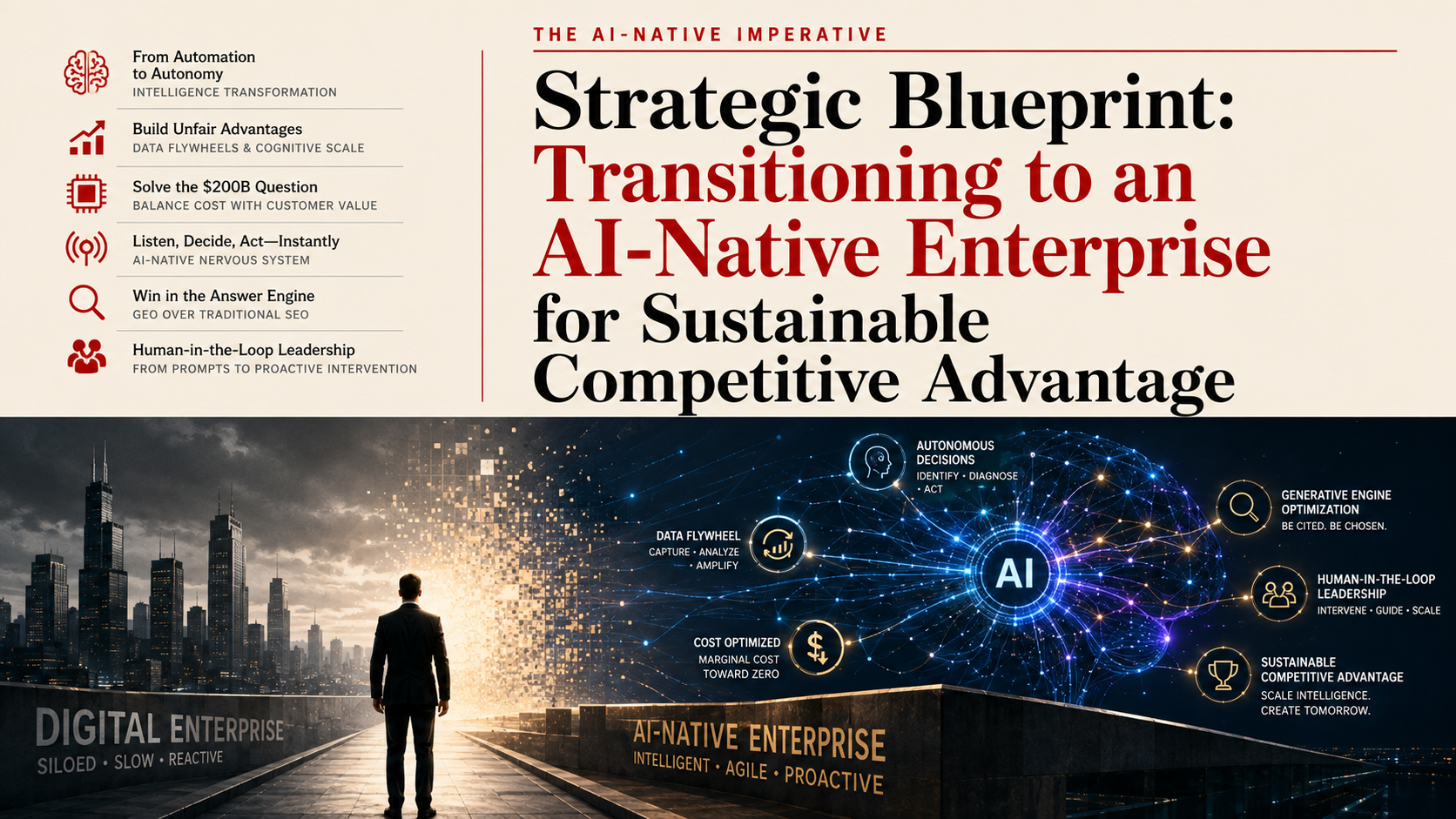
In the rapidly evolving landscape of modern business, the paradigms that once defined success are shifting beneath our feet. For the past two decades, organizations have dedicated massive budgets, countless hours, and significant human capital to the altar of “Digital Transformation.” This process—which was largely characterized by the transition from physical papers to digital pixels, moving data from local filing cabinets to cloud databases, and replacing manual logs with software-as-a-service (SaaS) dashboards—is no longer a source of competitive advantage. It has become a baseline operational expectation, table stakes for entry into the global marketplace. Today, the era of digital transformation is officially over, and a new, more profound paradigm has emerged: the era of Intelligence Transformation.
This intelligence transformation represents a systemic, fundamental shift in how organizations are structured, how they process information, and how they deliver value to their customers. Rather than relying on traditional software systems that act as passive tools to support human labor, the modern enterprise must transition toward an AI-Native architecture. In an AI-Native organization, artificial intelligence is not merely an add-on or a productivity tool; it is the core fabric of the enterprise, designed to run processes autonomously, make real-time decisions, and continuously learn and optimize without constant human intervention. For corporate leadership, navigating this transition is not just a tactical choice or an operational upgrade—it is a critical necessity for survival in a highly volatile and exponentially accelerating market.
The Imperative of the Intelligence Era: Embracing Exponential Acceleration
We are living in a business environment characterized by what strategists call the MAX phenomenon: massive, accelerating, and exponential change. Historically, technological and business cycles unfolded over decades, giving executives ample time to observe trends, conduct multi-year pilot programs, and slowly roll out changes across their organizations. Today, those cycles have collapsed to a matter of weeks, or even days. The speed-to-market of new technological capabilities is unprecedented, and the geopolitical and economic consequences are immediate. Consider a recent, striking example: when Anthropic’s Claude Fable 5 was released, its strategic implications and raw cognitive capabilities were deemed so disruptive and strategically powerful that the United States government issued an export restriction within just seventy-two hours of its launch. This level of rapid regulatory intervention is a stark reminder of the immense power of advanced artificial intelligence models and the speed at which the global landscape reacts to them.
To survive and thrive in this environment of constant disruption, forward-thinking leaders must pivot from “Automated” digital systems to “Autonomous” AI-Native architectures. While this distinction may sound like mere semantics, the operational and economic differences are vast. Traditional software, including robotic process automation (RPA) and standard digital workflows, targets a global software market valued at approximately four hundred billion dollars. This software is fundamentally passive, requiring human triggers, structured rules-based inputs, and manual intervention whenever an exception arises. In contrast, AI-Native systems target the global labor market—a addressable market that is thirty times larger, representing trillions of dollars. This represents a monumental shift from building tools that help employees do their work, to deploying intelligence that can perform the work itself, scaling cognitive capabilities exponentially without a linear increase in headcount or operational expenses.
The implications of this shift extend deep into the organizational chart, marking the end of the traditional “T-shaped” professional. Historically, the T-shaped model was highly prized: individuals with deep expertise in one specific area (the vertical bar) and broad, general collaboration skills (the horizontal bar) were considered the ideal workforce. However, as the cost of raw cognitive processing collapses toward zero, narrow specialized expertise is no longer a sustainable competitive moat. When frontier AI models boast IQ scores exceeding 150 and can perform complex legal contract analysis, write production-grade code, or conduct deep quantitative market research for a fraction of a cent, the traditional assumptions underlying labor expenditure must be radically reevaluated. The true value in the intelligence era lies not in holding static knowledge, but in the capability to orchestrate autonomous systems that can continuously generate, refine, and apply knowledge at scale.
Cultivating the Knowledge Flywheel and Unfair Strategic Advantages
How do AI-Native organizations engineer strategic advantages that their legacy competitors find impossible to replicate? The answer lies in the democratization of expertise and the construction of self-reinforcing operational loops. This is not a theoretical concept; it has been proven in the real world by visionary leaders. For example, Matthew Griffin, a former IBM executive, applied these very principles to build a multi-billion-dollar business unit with an incredibly lean team of just three people. By leveraging advanced artificial intelligence systems to automate research, pipeline generation, and customer outreach, this micro-team grew sales from two million dollars to three hundred and fifty million dollars—a staggering sixteen-thousand percent increase. They successfully outmaneuvered legacy competitors like Hewlett-Packard and Atos, proving that cognitive scale and technological leverage can easily dismantle the structural advantages of massive, slow-moving corporate incumbents.
At the heart of this operational leverage is the concept of the knowledge flywheel, a self-reinforcing loop where information circulates and compounds autonomously within the organization, a concept sometimes described as the autonomous circulation of wisdom. In a traditional company, knowledge is trapped in human silos—stored in individual minds, personal inbox folders, or static documents that require active human effort to find, share, and utilize. In an AI-Native organization, the knowledge flywheel operates continuously through three critical, autonomous phases:
- Ingestion: The system continuously and automatically captures every communication channel, customer feedback thread, market signal, and internal log in real time, converting raw enterprise interactions into structured data assets.
- Analysis: Advanced cognitive agents immediately process this stream of information, identifying underlying buyer intent, market shifts, and subtle behavioral signals that human managers would inevitably miss or ignore.
- Action: Autonomous agentic systems trigger immediate, targeted responses—whether that means generating customized product prototypes, initiating hyper-personalized sales outreach, or adjusting pricing models—long before a bureaucratic competitor can even schedule an initial internal meeting.
By implementing this autonomous loop, businesses can unlock the potential of a hyper-leveraged workforce. This is achieved by combining social intelligence, emotional resonance, and actionable execution into agentic systems. These digital agents operate twenty-four hours a day, seven days a week, processing and applying knowledge at a speed and volume that no human team could ever match. The disruptive potential of this cognitive scale is profound; when advanced LLM models proved they could pass professional licensing exams and automate routine legal drafting, the market reacted instantly, erasing significant market value from traditional, labor-intensive professional service firms. In the intelligence era, strategic amplification is the goal: using AI not to incrementally replace individual workers, but to amplify a small, highly strategic human team into a dominant global force.
Solving the Capital Dilemma: Balancing Infrastructure Costs with Customer Value
As enterprises rush to adopt artificial intelligence, they inevitably confront one of the most pressing economic questions of our time, often referred to by venture capitalists as the multi-billion-dollar GPU ROI challenge. The economic realities of building and running advanced AI models are brutal and unforgiving. As a rule of thumb, for every single dollar spent on purchasing advanced graphics processing units (GPUs) for AI computation, an additional dollar must be spent on the energy, cooling, and specialized data center infrastructure required to keep those chips running. If the global technology industry spends hundreds of billions of dollars on hardware and physical infrastructure, it requires a massive, multifold payback in actual recurring software revenue just to achieve financial break-even. Investing heavily in raw computing power without a clear, direct path to creating end-customer value is a dangerous recipe for capital destruction.
To avoid falling into this capital trap, executive leadership must shift their focus away from raw infrastructure and toward the generation of high-margin customer value. Every AI investment should be evaluated through a rigorous framework designed to maximize return on intelligence. This involves mapping AI capabilities to specific strategic objectives that drive top-line revenue or fundamentally rewrite the cost structure of the business. For instance, by leveraging generative models to automate complex engineering tasks, product design, or software development, the marginal cost of innovation moves toward zero, allowing the firm to prototype and launch new products in hours rather than months. Similarly, using intelligent agents to analyze deal psychology and customer intent in real-time can eliminate the common bottlenecks where sales opportunities stall, significantly accelerating deal velocity.
Furthermore, the application of hyper-personalization at scale offers an unprecedented opportunity to drive conversion rates. Traditional marketing approaches rely on broad segmentations and generic messaging that often fail to resonate with individual decision-makers. AI-Native systems, however, can dynamically synthesize highly customized content, technical proposals, and localized marketing assets for every single prospect based on their specific business needs, pain points, and behavioral history. Real-world data indicates that organizations leveraging AI to deliver this level of deep personalization see user-to-customer conversion rates that are up to five times higher than those relying on traditional, static digital search and marketing tactics. By focusing on these high-impact, value-generating applications, enterprises can ensure their AI initiatives yield healthy financial returns that easily justify the underlying infrastructure costs.
The AI-Native Operational Nervous System: Real-Time Listening and Closed-Loop Decisions
For an organization to operate at the speed of the intelligence era, it must be re-engineered to function like a biological organism, possessing a high-fidelity nervous system that senses external stimuli and triggers immediate internal responses. In an AI-Native business, this nervous system is constructed using advanced listening systems. These are continuous, automated monitoring pipelines designed to parse public and private data streams—such as executive interviews, industry news, social media discussions, financial earnings transcripts, and regulatory filings—to detect buying signals and strategic intentions long before they are formalized into public requests for proposals.
A classic, powerful illustration of this capability comes from the enterprise technology sector, where a major technology firm utilized automated listening systems to monitor the public statements and interviews of top retail executives. The system flagged that a senior vice president at a global retail giant had expressed a strong preference for private, highly secure cloud solutions over standard public cloud infrastructure during a panel discussion. Armed with this immediate, highly specific insight, the sales and engineering teams bypassed their generic sales decks and pivoted their entire pitch to focus on hybrid, highly customized private cloud architectures. This proactive, tailored approach allowed them to win a multi-million-dollar contract that their competitors—who were still pitching generic public cloud offerings—lost completely. This is the power of active, automated intent sensing.
To fully capitalize on these signals, the enterprise must eliminate the latency that typically exists between sensing an opportunity and taking action. This is achieved through closed-loop decision-making, which automates the transition from discovery to execution through a seamless, agent-driven workflow:
- Intent Sensing: Automated cognitive systems continuously scan communications, social channels, and document interactions to detect positive signals, such as a prospect downloading a specific whitepaper or lingering on a pricing page.
- Dynamic Content Synthesis: The system instantly generates a highly personalized proposal, custom deal scenario, or technical architecture document tailored to the exact psychology and needs of that prospect.
- Automated Approvals: Integrated AI legal and compliance agents review, edit, and approve the generated agreements and contracts in minutes, allowing the sales team to deliver a complete, customized proposal to the client while their interest and intent are at their peak.
Mastering the New Search Frontier: Generative Engine Optimization
As artificial intelligence models become the primary gateway through which consumers and business professionals access information, the traditional playground of online visibility is undergoing a massive disruption. We are witnessing the undeniable decline of the classic search engine results page, often referred to as the death of the blue link. For decades, businesses focused all their digital marketing efforts on search engine optimization (SEO), competing fiercely to rank as the top organic result on Google. However, with the rise of conversational search engines and retrieval-augmented generation (RAG) platforms like Perplexity, ChatGPT, and Gemini, users no longer click through pages of search results. Instead, they receive a single, synthesised, direct answer compiled by an AI agent, which summarizes the best available information and cites its sources.
This shift represents a massive challenge for traditional marketing, as click-through rates for traditional search results have dropped significantly due to these zero-click search summaries. However, it also presents an extraordinary opportunity: empirical data shows that users who discover a brand or product through an AI search recommendation convert into paying customers at rates that are four to five times higher than those coming from traditional, keyword-driven search engines. This is because AI-driven search queries are highly intentional, and the recommendations provided are contextualized specifically to the user’s detailed query. To win in this new landscape, organizations must transition from traditional SEO to Generative Engine Optimization (GEO).
To ensure that your brand, products, and insights are actively selected, synthesized, and cited by advanced conversational search engines, all corporate content must be structured to be highly machine-legible. Marketing and content teams must adopt an answer-first, semantically structured writing checklist:
- Clear Definitional Openings: Use explicit, simple declarative sentence structures, such as defining key concepts clearly in the introductory paragraph, making it incredibly easy for LLM scrapers to extract and use your definitions.
- Verifiable Empirical Data: Ensure all claims, arguments, and case studies are backed by clear, cited statistics and numerical data, as research shows that content containing well-structured data points experiences a forty percent increase in citation rates by AI search models.
- Semantic Document Hierarchy: Use clean, nested HTML heading structures and write short, semantically complete paragraphs that retain their full meaning and context even when extracted as isolated text chunks during the vector retrieval process.
Rethinking Organizational Architecture: Agentic Management and Employee Amplification
Building an AI-Native enterprise requires far more than simply giving employees access to a chat interface and expecting them to figure it out. It requires a complete re-architecting of the organization’s management philosophy, operational structures, and workflows. Traditional management is built around human-to-human delegation and manual follow-ups. In contrast, AI-Native management is built on agentic workflows and the hierarchy of agency, which categorizes systems and employees based on their level of proactive problem-solving capability. While low-agency systems simply flag issues and wait for instructions, high-agency agentic systems identify challenges, diagnose the root causes, develop viable solutions, execute those solutions, and present the human manager with a complete, completed task requiring only final validation.
To successfully transition a traditional business into an AI-Native powerhouse, leadership must execute a structured, phased roadmap that systematically builds and scales these capabilities across the company:
- Systemic Recording and Capture: Focus on capturing the raw data of the organization by implementing automated transcription, logging, and documentation for all meetings, sales calls, and internal communications, establishing the foundational data assets for the knowledge flywheel.
- Operational Metric Standardization: Define and measure key performance indicators that track AI adoption and database hygiene, such as measuring the speed of CRM updates within a twenty-four-hour window and tracking the utilization of AI-driven insights across active sales pipelines.
- Autonomous Knowledge Integration: Deploy advanced digital agents that can autonomously identify successful performance patterns, synthesize best practices, and distribute those insights across different teams without requiring manual human training or intervention.
By shifting routine data collection, reporting, and information-sharing tasks to autonomous agents, organizations can effectively bypass the traditional limits of corporate scaling, such as the famous Dunbar’s number, which suggests human groups face severe communication friction once they exceed a certain size. AI-Native architectures allow lean, highly aligned human teams to manage operations, process information, and serve global customer bases at a scale that previously required thousands of employees, unlocking unprecedented levels of organizational agility and profitability.
Seizing the Strategic Advantage in the Era of Ultimate Leverage
The journey toward becoming an AI-Native enterprise is not a project with a fixed end date, nor is it a simple IT upgrade designed to shave a few percentage points off the operating budget. It is a fundamental, irreversible transformation in how value is created, distributed, and sustained in the global economy. In an era where the cost of raw cognitive processing is plummeting and the speed of market disruption is accelerating exponentially, relying on yesterday’s digital playbooks is a guaranteed path to obsolescence. Corporate leaders must recognize that incremental improvements will not protect them from competitors who are operating with infinite cognitive leverage.
To secure a dominant position in this new landscape, executives must act with decisiveness and strategic vision. This means moving beyond pilot programs and superficial tool adoption to fundamentally rewrite the operational DNA of the business. By focusing resources on building self-reinforcing knowledge loops, establishing robust real-time listening systems, and structuring all corporate content for the age of generative search, organizations can build structural advantages that become stronger with every transaction and interaction. The window of opportunity to establish this dominant operational foundation is open now, and those who move first will capture the lion’s share of the value. The era of the simple digital enterprise is behind us; the era of the intelligent, autonomous, and highly leveraged enterprise has arrived. The future belongs to the architects of intelligence.